Silvia Federici’s manifesto Wages against Housework provided an early impetus for Ina Ivanceanu to raise her own awareness of care as an invisible social and economic factor
– and her film communicates that awareness to the general public. WHO CARES is a proclamation of exhaustion which permits
a glimpse into private spheres: it shows both protagonists and the director in their everyday lives, a considerable proportion
of which is devoted to caring for a family member. It wasn’t always planned that way for the film, but it’s no coincidence,
either. It’s a system.
WHO CARES introduces the subject from two angles: theory and practice. The philosopher Silvia Federici reads facts and figures
about unpaid care work, and then we see you, the director, in your private life, busy with everyday issues surrounding care
work. When did you encounter Silvia Federici’s research?
INA IVANCEANU: As a student, I came across her manifesto Wages against Housework, because at the age of twenty I was looking for my own
feminism, working out what kind of relationships I wanted with men (and what kind I didn’t), and how I wanted to shape my
life: with children or without them. I was travelling a lot, and I was interested in the global perspective: does this inequality
and injustice between the sexes exist everywhere? This brought me into contact with Silvia Federici’s manifesto and works
by her comrades-in-arms from the seventies which address the question: How can women+ free themselves from these roles and
the huge quantities of unpaid work? Even then she criticized Marx for his failure to appreciate just how much this unpaid
work amounts to, and what the economic consequences would be of taking it into account. Her bestseller Caliban and the Witch
was published in 2004; it deals with the ways that capitalism and patriarchy are interconnected. Seeing how events from the
period of witch hunts still impact me today was a real eye-opener. Silvia’s research shows how important unpaid reproductive
work is for the capitalist economy.
In the second scene you, the director, also present yourself as the protagonist, performing care work in your mother’s chaotic
apartment. Making part of your private life public like that can’t have been a decision you took lightly. But at the same
time, it goes to the very heart of the problem: should care work be liberated at last from the nimbus of the private?
INA IVANCEANU: In general, I don’t think there’s any such thing as the private. Everything we do also has consequences in society and politics.
Everything is connected. We don’t live private, public and political lives; we live exactly one life. We only have one. And
injustice flourishes precisely because this fact is so well hidden, and the care situation is allowed to slide into the private
sphere. I want to work against that.
A few months ago, the Austrian Chancellor expressed the view that childcare was not unpaid work, and the family was not a
business case. The reactions were quite loud. Do you see this as confirmation that your film is of great contemporary relevance?
INA IVANCEANU: Our society likes to sugarcoat unpaid work, especially in the context of children and members of your family: people you
love, in the best-case scenario. We paste a sticky layer of love on top of it – and then you can’t call it work. Which is
a good way of hiding who is doing it and how unfair it really is. Silvia and her comrades-in-arms asked one of the basic questions
of my film back in the 70s: Is it love or unpaid work? It’s not a matter of either-or. I say: Yes, it can be love – and yet
it is work. The Chancellor’s statement also shows the fear of calling a spade a spade. I don’t want to see my daughter as
a business case either, but the only thing that keeps us afloat is ruthless honesty, rooted in numbers, facts and contexts.
After that, you can talk about love. But the more unpaid work you do, the more love tends to take a back seat. Every person
who cares for others knows that. This is the idea that drives me: I don’t want to lose love from my life. Putting a sticky
layer of "love" on top of the facts won’t help us.
Silvia Federici also embodies theory and practice in WHO CARES. In her eighties, she herself became an unpaid care worker;
she looks after her sick husband. How did your exchange with her develop?
INA IVANCEANU: Silvia is a very much an activist, and thanks to her experiences in the Global South, especially in Latin America and sub-Saharan
Africa, she thinks very transnationally; she always includes racism and exploitation by the northern world in her analyses.
Then I found out that she’s caring for her own partner. She has an incredibly strong relationship with George, who is also
an author; they’ve been together for many years. That means there is a lot of love. And yet, of course, it’s the same dilemma
for her. I wanted to know how she deals with it, whether it helps if you know more about the broader background.
I contacted her several times and wondered why she didn’t answer. George was ill by that stage, and she had hardly any time.
Somehow, I caught up with her anyway, and we had an exciting, funny conversation via Zoom. Then she said: “I’m in Parma right
now; if you like, you could come and visit me”. Three days later, I was on the train to Parma with a small team. We did some
test shoots, cooked, ate, talked together... It was a lovely meeting. At the end, she said: “We’ll put down on a piece of
paper now that I’d like to be your protagonist, and I’ll sign it.” The filming took place over several years. Her life changed,
George got worse. The more she had to care for him, the more effort she made to go outside, take him to conferences, etc.
She said: “I’ll do anything to make sure we don’t disappear from view; we’re not embarrassed, we’re not hiding it”. That impressed
me very much.
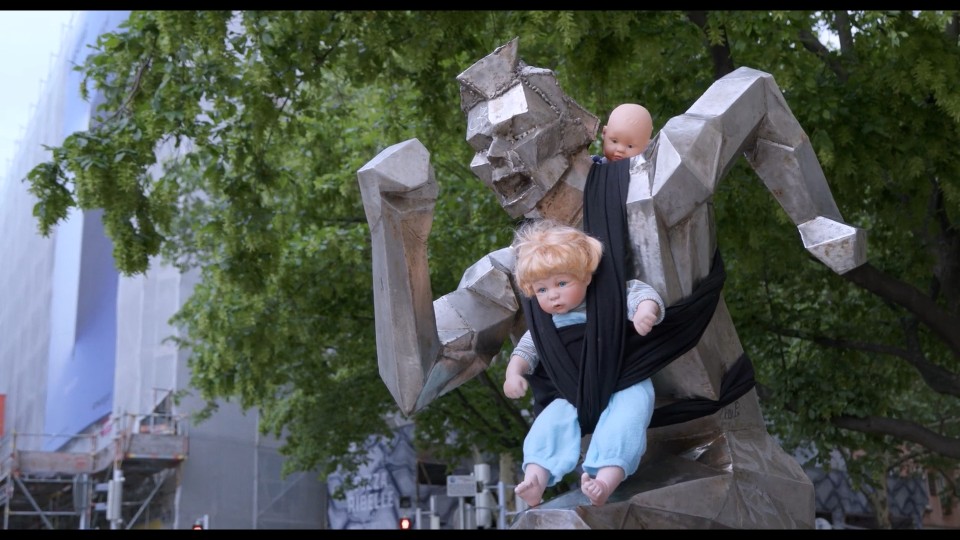
Silvia Federici reads from her manifesto against the backdrop of a statue. And in the film you also focus on monuments in
Vienna. What conclusions did you reach?
INA IVANCEANU: Silvia is in a square in Parma, with the statue of an anti-fascist partisan behind her: a statue of a man with a rifle. That
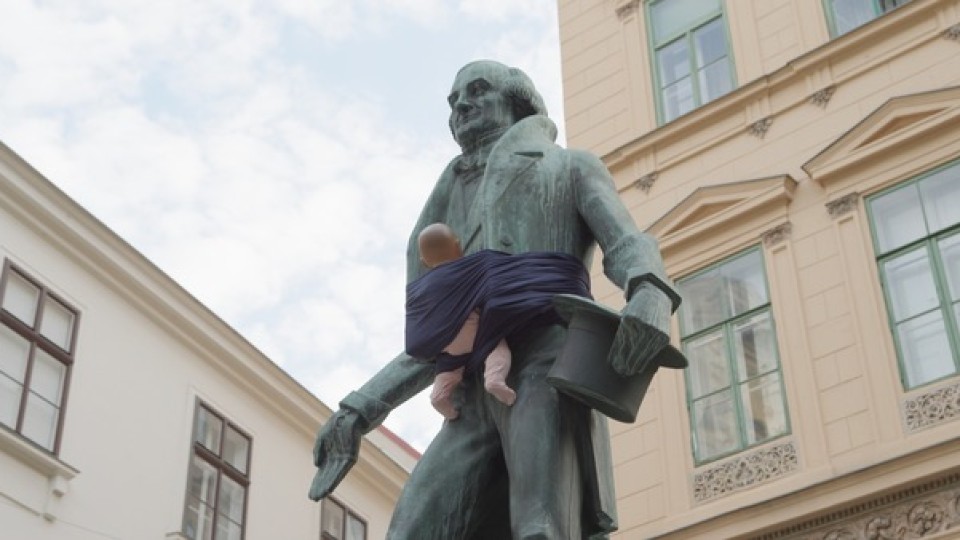
memorial is very important to Silvia. At that time, I had already done some work on statues in Vienna and the question of
who is depicted in public spaces, and how, and I was struck by how many statues there are of named males. There are about
6 statues of females, compared to about 190 statues of males who are identified by name. We are influenced by what is on show
in public spaces – and what isn’t. I also took a close look at the general tone of these representations of men and women:
men – and this is really painful and sad to look at – are solitary, warlike and violent. Powerful, but in a repulsive sense.
In contrast, with women the attributes of caring and motherhood are in the foreground
and most of the time they are naked
or wearing very little.
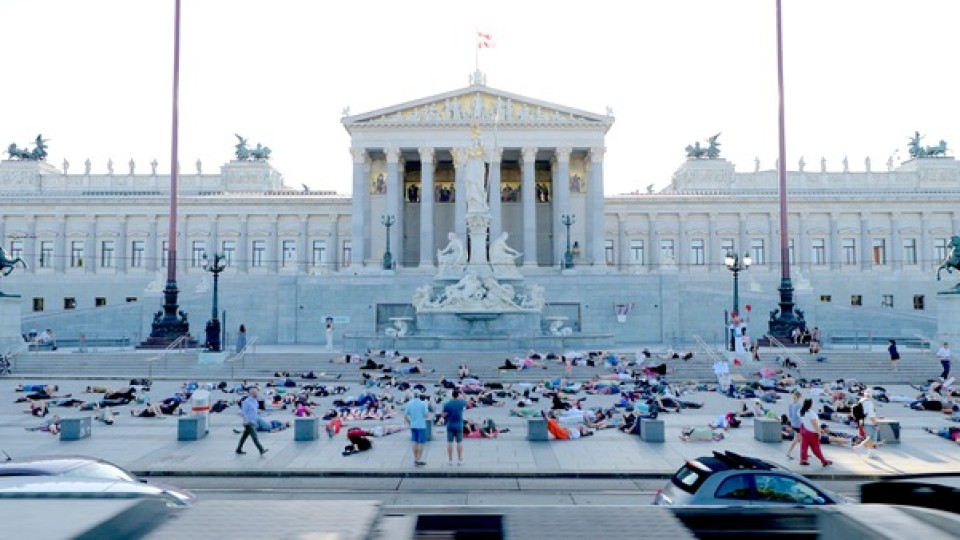
One gesture runs like a leitmotif through the film: that of an exhausted woman lying down on the ground. As the film progresses,
more and more people express their exhaustion in public. How did this gesture come about?
INA IVANCEANU: It got to a point where I was really exhausted, and I didn’t know how to reconcile shooting the film with the whole care situation.
That was when it became clear that I had to address this in the film as well. I just lay down on the floor in the living room
and realized what a pleasant feeling it was. The next step was when I thought to myself: “How would it be to do this outside,
in public?” Then it developed a momentum of its own: I thought it was visually beautiful, and I felt good about it. And then
I did it more and more, and a group came into being – #stillgelegt – which is still very active.
We learn in the film that you are a sandwich woman, caring for growing children and elderly parents at the same time. "Alongside
all that" you work full-time, and you’ve made a film, which is a 24/7 task in certain phases. How did you manage it all?
INA IVANCEANU: A lot of people helped in the background. I personally find it hard to endure a situation when someone needs me and I’m not
there. It meant maintaining a balance between different situations: “Unfortunately, I’m not there now, even though I’d like
to be”, or “I’m shooting now, but I’ll interrupt it anyway,” or “I’m shooting now, and I can’t possibly interrupt it, because
then something really crucial would change, and I don’t want that”. It was a balancing act; every day of shooting is a new
decision. When you’re shooting – or editing – a film, you often face really difficult challenges. The compatibility of filmmaking
and family or care obligations is a huge issue anyway, and unfortunately, it’s still completely unresolved.
In fact, the subject matter of your film and the reality of life were constantly interlocking...
INA IVANCEANU: Making a film takes time. During the time you’re making that film, your own life changes – and in my case, my mother changed
during that time, which meant the way I lived my life changed too. At some point it became clear that I could only make this
film meaningful if I let my own situation flow into it. What is happening to me happens to so many other people, and we don’t
see it; we hardly ever read about it, we don’t feel it, we don’t talk about how complicated it is, even with friends. A world
has come into being around us where you are supposed to work as if you had no children, no family, no friends, no friendships
where you might have to give something. And on the other hand, as a woman you’re supposed to act as though you don’t work.
It’s an irreconcilable contradiction that creates huge difficulties for very many of us. I’d really like to dispel those myths.
Nobody should try to perpetuate that. We should finally stop doing it. I want to stop pretending that these two worlds don’t
exist. For me, it’s often the case that unpaid care and my paid work confront each other like archenemies. I don’t want that
anymore. Anything I can do to change that, I will.
Interview: Karin Schiefer
October 2026
Translation: Charles Osborne