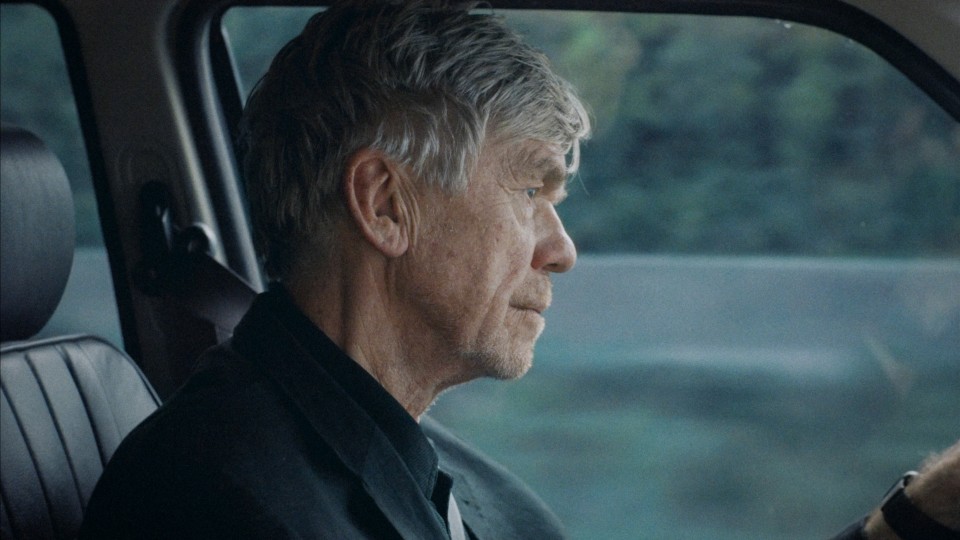
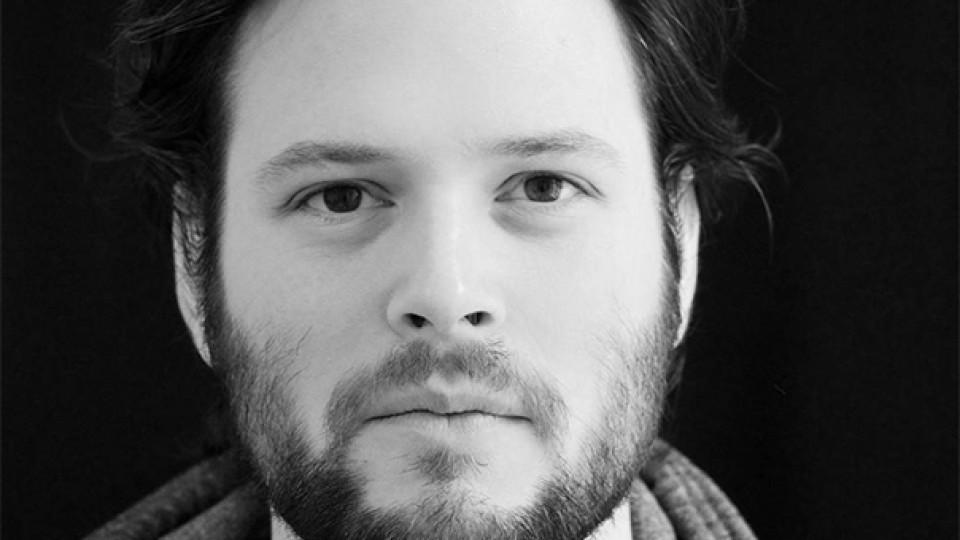
In LONDON, as in your last film Movements of a Nearby Mountain, the car and the landscape – which is to say the mobile and the immobile – have an essential role to play. Can you tell us
something about the process underlying the concept for this film?
SEBASTIAN BRAMESHUBER: The car almost inadvertently became an important part of the film again. What unites my films is the question of how the past
permeates the present – how 'big history' affects everyday life at a personal level. The idea for LONDON goes back a long
way. It started when I myself was often on the road between Vienna and Berlin, getting lifts. I noticed that during the time
you’re 'sitting out' the journey together in the car, something happens to you and the person next to you. You start talking,
but instead of looking at each other, you both tend to stare straight ahead at the "landscape film" beyond the windshield.
The result is a conversation with a slow rhythm and moments of silence, and this bears a certain similarity to the psychoanalytic
situation. I thought this setting could say something about the state of the present. For my film Of Stains, Scrap and Tires,
Bobby Sommer recorded a poem; that's how we met. He told me about his life, I told him about my idea. From that moment on,
we were in dialogue.
Did the screenplay for LONDON emerge with him in mind as the main character?
SEBASTIAN BRAMESHUBER: I thought Bobby might be good casting for the driver, because I knew him as someone who has a genuine interest in a wide
variety of people. At the same time, I became interested in the West Autobahn, because what you see along the highway is literally
landscaped: the "landscape film" beyond the windshield is based on a "script" written by the Nazis, who wanted to set out
the most picturesque route possible between Salzburg and Vienna. My father died in 2019. During that period, I had to drive
up and down the West Autobahn in a state of mourning. The history of the highway took a back seat, and I started thinking
about how many different personal stories were in motion on that road at that moment – in the car in front of me, next to
me, behind me. That provided the impetus for Bobby's backstory. My main character would be someone who was grieving or in
mourning for something.
LONDON is a fictional narrative in an everyday setting. The levels of fiction and non-fiction become blurred; did you want
the dramaturgy to leave that question open for as long as possible?
SEBASTIAN BRAMESHUBER: People like to talk about a border zone between the documentary and the fictional, but there is no border; the two states
flow into each other to a greater or lesser extent, always in motion and negotiation. What particularly appeals to me is creating
a tipping point and then keeping the question of reality and fiction simmering constantly.
How meticulously did you cast the passengers, in order to create the illusion that it was all random?
SEBASTIAN BRAMESHUBER: Bobby Sommer was clear from the beginning, and I wanted Cliff, who played the lead in my last film, to be part of the action.
There’s only one professional actress: Anca Cipariu plays the Romanian migrant worker. We held some auditions with very precise
specifications: for the role of the conscript, for instance. Paul quickly emerged as ideal for that part. But we also held
more unspecified auditions with young people. We engaged them in informal conversations to find out who they are – whether
they 'wear their hearts on their sleeves' while still being reserved to some degree. In the end, the only people who are interesting
on camera are those who have a certain enigma about them. Two themes played a crucial role in the selection: war, and the
migration associated with it – but from a personal perspective, so they could be related to the great, impersonal history
of the West Autobahn.
Did you prepare the actors for filming together with Bobby?
SEBASTIAN BRAMESHUBER: Generally, the passengers encountered Bobby for the first time when the camera was turned on. The idea was for them to meet
each other as strangers. It was important for me to keep the conversations as free as possible. Everything that seems to happen
at the same time now – shot and reverse shot – was actually filmed with two or three hours in between, sometimes more. The
unity of time and space was only re-established in the editing.
How would you describe the studio set for the shoot?
SEBASTIAN BRAMESHUBER: For the studio shoot, we first we had to shoot the plates: the shots of the landscape passing by. We did that for two to three
hours at a time – always driving from Vienna to Salzburg with three cameras: out on the left, out on the right and out in
front. Then, in the studio, next to the car there was a large screen as a rear projection, without a green screen. There was
also a large screen in front of the windshield. We wanted this set-up to be as close as possible to a real journey along a
highway, also in terms of the time you have to sit together in the car. The plates were produced a year before the shoot,
so we could then go through the seasons, day and night, sun and rain, during a studio shooting block of about a week and a
half. Logistically, it was extremely complicated.
How did the filming proceed, in concrete terms?
SEBASTIAN BRAMESHUBER: First, the camera would always be pointing at the passenger; after between an hour and an hour and a half, we would reverse
the set up. The camera moved to the other side, as did the screen for the background, and we repeated the whole thing loosely.
There would be someone sitting in the back of the car to make sure it bounced a little during the "drive". The particular
point about a studio is that it’s very quiet. If you were filming during a real car ride, you wouldn’t really end up with
this calm atmosphere. Bobby also had a button in his ear, the one facing away from the camera, so I could communicate with
him. I encouraged him to let the passengers dictate the rhythm of the conversation. It was particularly important that he
should show restraint; when you’re shooting without predetermined dialogue, you can feel obliged to keep the conversation
going. It’s not easy to tolerate moments of silence, or uncertainty about what’s coming next, because you get the feeling
that nothing important is happening. But that’s usually a fallacy – on the one hand, because you can cut things a lot during
the editing, but also because precisely what is initially perceived as meaningless is often what’s essential for the authenticity
of the whole.
Towards the end of the film, the narrative takes on a slightly dystopian character, with military personnel checking the route.
How much did the war in nearby Ukraine play into the narrative?
SEBASTIAN BRAMESHUBER: It was a combination of personal issues, the historically charged location of the West Autobahn and current developments
– especially the war in Ukraine, which is full of echoes from the past, as was the case with the Balkan war. I tried to picture
the highway as more interesting than it is on a superficial level; as a river, where History and personal stories are deposited
on its banks like sedimentary layers. Today, hardly anyone thinks about the history of this highway. But it does forge a path
into the present, via detours: via Bobby, who blames his father's war traumas for their family conflicts; via Jon, who feels
that the partisan legacy of his grandparents has influenced the formation of his identity a good eighty years later; via Polina
and her family's escape from the war in Ukraine; and via Paul, who is plagued with moral questions about military service.
But I wasn’t only concerned with ghosts of the past; there’s also fear of the future – for myself and also for my son and
the next generation – when war in Europe is suddenly a real possibility again.
Under the Nazis, only a short section of the West Autobahn was built in the end.
SEBASTIAN BRAMESHUBER: Immediately after the Anschluss in March 1938, the groundbreaking ceremony was held at Walserberg. Although only a short stretch
to Salzburg was built, the entire route had been planned out, and many sections were cleared and leveled at that time. What’s
more, bridges and viaducts were built in Salzburg and Upper Austria which carry the West Autobahn today. At the end of 1941,
all work was suspended due to the war. Construction wasn’t resumed until the mid-1950s, with the West Autobahn also serving
as a symbol of the Second Republic's westward orientation. Today, cars go much faster, the volume of traffic is higher, noise
barriers and trucks obstruct the view – the focus on the landscape has declined. But the lines of sight with Melk Abbey, Traunstein
Mountain and the route along the Salzkammergut lakes are by no means accidental. The ideology of the past, the instrumentalization
of the landscape, is physically embedded in the foundation and in the perspectives provided by the highway.
What was the idea behind the title, LONDON, which seems incongruous geographically?
SEBASTIAN BRAMESHUBER: I don’t see the title as mystery; there’s an associative interaction with the film. The most obvious reference is Bobby's
time in London when he was a young man. London stands for what it meant to him back then: freedom and the opportunity to be
who you want to be. And perhaps London is also the place where Bobby and Arthur's friendship or relationship had its real
home. On a mental level, the title reflects the way your mind wanders during a drive like this; in this state of being on
the move, being in a corridor-like non-place, you soon reach out for other times and geographies. For me, the title opens
up the narrow space of the car to a mental geography and to a destination that’s more of a feeling. London is also a city
beyond the mainland that can’t be reached by road alone. There’s a similarity with the past, which Bobby pursues in the film:
it is ultimately unattainable, no matter how far he drives.
Interview: Karin Schiefer
January 2026
Translation: Charles Osborne