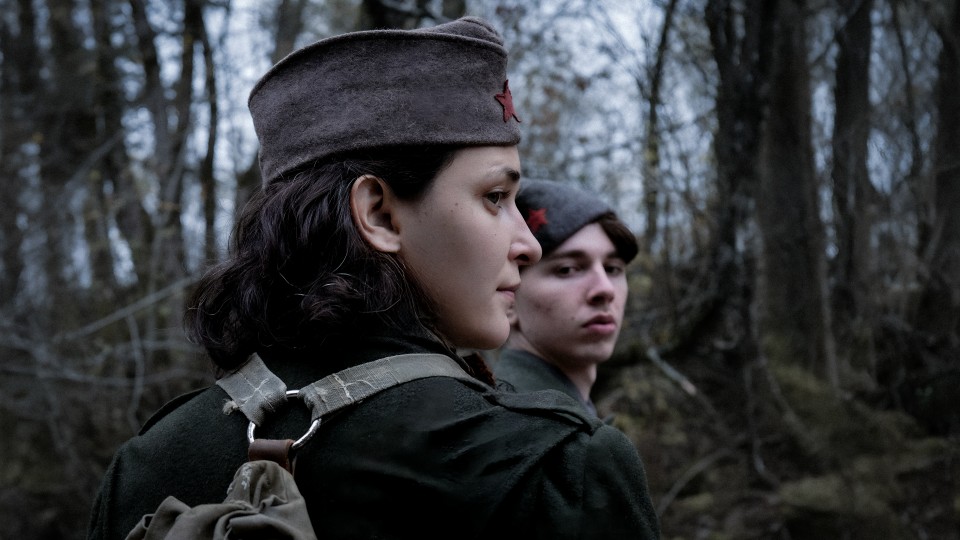
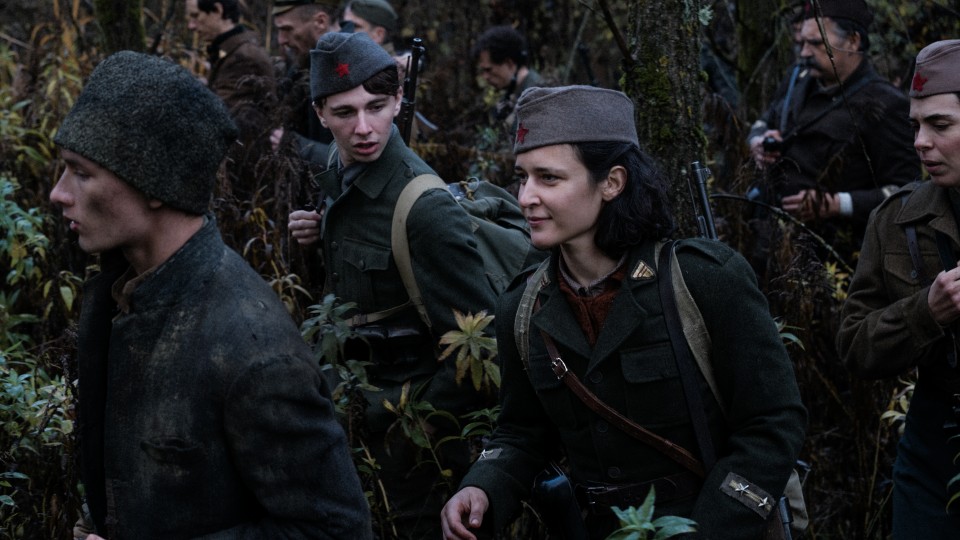
Mila has survived relatively unscathed after years of fighting the Nazi regime as a partisan in the forests of the southern
Carinthian mountains. However, liberation only brings short-lived relief. Because after the war, the tide turns quickly. Andrina
Mračnikar’s films show us what cannot be found in history books. In MILA / MARIJA we see how volatile perspectives on right
and wrong can be in post-war times – and that for Carinthian Slovenes, although a war came to an end, their struggle for political
recognition and equality never has done.
In your cinematic works you consistently focus on the history of the Carinthian Slovenes, most recently in the documentary
Disappearing/Izginjanje. For MILA / MARIJA you chose a fictional approach; which facet of this complex historical background
did you want to focus on?
ANDRINA MRAČNIKAR: I have wanted to make a Carinthian-Slovenian partisan film for a very long time, due to my personal links to the Carinthian-Slovenian
resistance but primarily because there has never been an Austrian feature film about this partisan movement. The resistance
mounted by the Carinthian Slovenes was the only sustained, organized, armed struggle against the Nazis throughout the entire
Third Reich. There were other forms of resistance, of course, but this was the only one that lasted – and the fact that it
made a significant contribution to the liberation of Austria from National Socialism has never been appreciated in Austria.
Partisan films had a long tradition in Yugoslavia and have also featured in many other countries. The idea for the film came
about before my documentary Disappearing / Izginjanje, and the first treatment had been drafted before we shot the documentary. But for various reasons, Disappearing / Izginjanje was more urgent, and MILA / MARIJA had to wait.
Was your protagonist, Mila, inspired by one or more real individuals?
ANDRINA MRAČNIKAR: Everything that features in the film is inspired by a real individual or event, or more than one. Mila's father is very much
based on my great-grandfather. The other characters are derived from several people who were actually alive at the time; that
includes the character of Mila. You have to remember that a lot of the partisans didn’t survive, and also that the mood after
1945 was such that you couldn't talk about those experiences. Suddenly, the resistance that had been mounted during the war
was discredited, the partisans were labelled bandits, and attacks on the Slovenian population continued even after 1945. There
was never a climate of openness in Austria where these stories could be told. Fortunately, there were people – especially
in the Slovenian population but later German-speaking individuals too – who were committed to recording eyewitness accounts.
Their accounts, as well as the book by Helena Kuchar Jelka: From the Life of a Carinthian Partisan, provided me with female examples which I drew upon in creating the character of Mila.
How high was the proportion of women among the partisans, and how were they recruited?
ANDRINA MRAČNIKAR: I don't have any exact figures, mainly because it’s hard to analyse. For a long time, only the fighters in the forests were
regarded as genuine partisans, until research made it clear that partisan resistance was only able to function thanks to a
very broad support network in the general population, and that was almost entirely provided by women. Men were more likely
to go into the forests, not least to escape being drafted into the Wehrmacht; a lot of them had already been at the front,
came home on leave after being wounded and then deserted – like my great-uncle Andri, for example. Women tended to be the
ones who built and maintained the supply networks, obtained medicine and food, and recruited men who had returned on sick
leave. When women did go into the forest it was more likely to be the result of betrayal, or they were motivated by a very
dangerous situation that forced them to escape in that way.
Where did you conduct your research? What historical facts did you want to highlight? What agenda did the Nazis pursue in
Carinthia, and when did they begin?
ANDRINA MRAČNIKAR: I’ve been working on this subject intensively for a long time, and I find that I have to explain many things over and over
again, because there’s so little basic knowledge about it. The intention of the Nazis was to "liberate" Carinthia from Slovenians,
although in 1920 over 90% of the population of southern Carinthia spoke Slovenian. From one day to the next it was decreed
that Carinthians had to speak German. The plan was to resettle or exterminate the entire Slovenian-speaking population. The
first step was to outlaw Slovenian completely in public places; people were forbidden to speak it in churches and in schools,
although most people didn’t speak German. In 1942 there was a large wave of deportations; people were selected at random and
deported to labour camps in Germany. Either their farms were left empty or German-speaking families from the Kanale Valley
or South Tyrol were settled there. For MILA / MARIJA, I was able to draw on many years of research, as well as the history
of my own family and reports from contemporary witnesses. This time, my focus was very specifically on the Carinthian-Slovenian
ethnic group. Of those people who joined the resistance, most came from peasant families and didn’t have intellectual backgrounds
or sophisticated political awareness. It was predominantly a struggle for survival for those people, and it received little
attention in Austria. In Slovenian-language academic literature, the works of Marjan Linasi are very important; unfortunately,
they have only been partially translated into German. This research complemented my own in an interesting way, because it
provides a precise, holistic overview of how the resistance movement developed among the Carinthian partisans. I also consulted
Marjan Linasi on certain questions.
In one scene, Mila's father says: "Well, they can hardly expel all the Slovenes." Did people initially underestimate the Nazis'
ruthless determination?
ANDRINA MRAČNIKAR: I don’t think anyone could really imagine how far they would go. After all, 90% of the population spoke Slovenian. How could
everyone be driven away? This actually strikes me as a marker of fascist dictatorships; at first, people simply can't believe
what’s going on. We’re also experiencing this today: things are happening that were previously considered unthinkable. In
dictatorships, sometimes things happen insidiously, but often they move with astonishing speed. The resettlement and deportation
of the entire population was definitely unimaginable at first.
MILA / MARIJA is also the story of a woman who has a position of responsibility in a military hierarchy; she has to assert
herself, and in doing so she is confronted with both goodwill and misogyny. What aspects did you have in mind when you created
your main character?
ANDRINA MRAČNIKAR: I wanted the film to adopt a female perspective: that of a woman engaged in armed resistance. The situation has a huge number
of aspects which I feel could be included, and it wasn’t easy to distil them and decide what the core of my narrative should
be. I felt it was very important to focus on the decisions that have to be made in times of war, and the consequences they
have. In my family my great-uncle, who was 20 years old at the time, decided to desert and join the partisans; in doing so,
he put the family in great danger, and in the end they were deported to labour or concentration camps. You make a decision
which seems "right", but it can have fatal consequences. And what about the system you are part of when you engage in that
struggle? If the fight is to be successful and you want to survive, there have to be rules – of course that makes sense –
but when you look at individual cases, contradictions emerge, and it becomes more complicated. Of course, someone on guard
duty wasn’t supposed to fall asleep, which would endanger the whole unit, but on the other hand, everyone was completely exhausted
and hungry, and of course people did fall asleep. Anyone caught sleeping on guard duty three times was to be shot. That was
the rule. I was interested in the contradictions. The ideology adopted by the partisans stated that women were equal to men
in principle, but in practice they weren’t. Of course, everyday life included misogyny and inequalities. Mila becomes a political
commissar, and we see that women did sometimes have the opportunity to advance, but it wasn’t the rule. I depict Mila as someone
who is very inquisitive, with a strong sense of injustice and a powerful bond to her father. She reacts very quickly to injustice,
even if she suspects that doing so will have negative consequences for her. It becomes even more difficult when these consequences
also affect her family and other people. After the war, the responsibility she has for her family and then also for her child
is very important to her.
The film shows that liberation from Nazi rule didn’t really change much for the Slovenian population – and that, on the contrary,
the situation which developed then actually involved a reversal of right and wrong.
ANDRINA MRAČNIKAR: That’s something I found out about at a very early stage, and it was the saddest and most incomprehensible thing I discovered.
The British initially supported the partisans, with liaison officers and supplies of food and weapons. But after 1945, fear
of communism flared up very quickly; this was among the first signs of the Cold War. Suddenly, the British were more afraid
of the partisans than of former Nazis. I remember interviews with contemporary witnesses who described their joy at being
able to return home, the hope they cherished
but then they were arrested again – by the British occupying forces who had
previously been their allies – and Slovenian events were sabotaged. It was still dangerous to speak Slovenian. It was a huge
shock for many people, and something like that wears people down in the long run.
I remember that in the summer of 2025, just before we started filming, the police raided an anti-fascist youth camp at Peršmanhof,
the site of the only museum marking Carinthian anti-fascist resistance. The camp was stormed by police helicopters, vehicles
and dogs. A judicial investigation established that the raid was carried out arbitrarily by the local police, but nobody has
been held accountable. This demonstrates that the conflict is very much alive today. Actions like that are intended to spread
fear and to intimidate people. While we were there, bilingual place signs in the areas where we were filming were smeared.
At first, I could hardly believe things like that were still happening today. And the list continues in 2026. It is disturbing
that anything associated with Slovenes can still be used as a blank canvas where people project fears and hostility. In the
latest revision of the Carinthian state constitution, both German and Slovenian were to be recognized as official languages,
but in the end, at the insistence of the conservative Austrian People’s Party, the draft was reformulated to exclude Slovenian.
Was this the first time you wrote a screenplay in Slovenian?
ANDRINA MRAČNIKAR: I first wrote the screenplay in German, and it was developed with Amour Fou and Barbara Albert as dramaturg. For the last
revision, Jürgen Karasek was added as another dramaturg. Only then was it translated into Slovenian, which was a very particular
process in this case, because nobody in the film speaks standard Slovenian; everyone has a different dialect and idiom. Mila
uses a very strong dialect with her family and modifies it when talking to other partisans. It took a long time to work that
out exactly.
What were the linguistic consequences of this approach, for casting and filming?
ANDRINA MRAČNIKAR: I felt it was essential for us to be authentic in linguistic terms, with all the nuances involved. The Slovenian spoken in
Ljubljana over 50 years ago was very different from the dialects people used in Carinthia. The question was whether we could
find actors willing and able to learn these niceties of the language in a plausible way. Which meant that dialect auditions
were an integral part of the casting process. Doroteja Nadrah, the actress from Slovenia who plays the main protagonist, didn’t
speak German, and the Carinthian-Slovenian dialect she had to learn for the film was like a foreign language to her, with
completely different sounds. She had a year to familiarize herself with this very particular dialect, with the help of our
dialect coach Marta Polanšek, and she was extremely committed to the task. In the end, she also spoke that dialect outside
her role in the film, so I could often ask her about individual words, since I'm not so familiar with this dialect myself.
Oskar Haag, who plays Mila's brother, didn't have such a hard time in that way, perhaps partly because the intonation of Carinthian
and Carinthian-Slovenian aren’t so different, and he didn't have to learn new sounds like Doroteja; she found our "R" a huge
challenge at first. I really wanted Leon Lučev in the film. He's Croatian, and we gave his character an accent from Bela Krajina,
a region in Slovenia on the Croatian border, which helped capture the real linguistic diversity among the partisans. He also
had to practice that dialect with a coach. On set, our team mainly consisted of people from Slovenia, Austria and Slovakia,
while some of them also had a background from countries of the former Yugoslavia, which meant that BCS (Bosnian-Croatian-Serbian)
also featured a lot. So there was a mixture of languages and dialects, although of course English was also very present.
There’s a lot of singing in MILA / MARIJA: within the family, among the partisans, in church and during the celebrations after
liberation. Singing is a crucial narrative element. What is the role of that sound, which is polyphonic yet shared, in your
narrative?
ANDRINA MRAČNIKAR: Singing is an extremely important aspect of Carinthian-Slovenian culture; the songs are considered particularly beautiful
and touching, and they have also been adopted by the non-Slovenian-speaking population. And there are plenty of jokes based
on the idea that Slovenes are forbidden to speak, but at least they’re allowed to sing. I myself have never had a special
affinity for singing, at least not for singing in public. But the partisan songs were an essential part of the resistance
struggle, providing encouragement and comfort as well as having a unifying effect; they’ve been part of my life since childhood.
Slovenian songs were also sung in the camps, including Dachau concentration camp, such as Lipa zelenela je. That song is ostensibly "only" about a lime tree that has withered and will lose all its leaves in winter but will bloom
again next spring; it invites the singing birds into its branches. In fact, it’s a deeply political song; the lime tree has
always been regarded as a symbol of Slavic Slovenian culture, in contrast to the German oak. It’s a sad song, sometimes mournful,
but at the same time it gave people courage. Actually, the idea that those songs and the act of singing them should become
a powerful, targeted element of the film wasn’t in the script: I only made that decision shortly before we began shooting,
when it became increasingly clear to me that these songs had to be in the film. I already knew some of them, but I did a lot
of research to find suitable songs – and in some cases the lyrics were almost uncannily appropriate to the script: as if the
scene had been written for that song.
You structure the narrative (in terms of the seasons), by featuring long shots of the countryside. That produced the impression
for me of the landscape as a unified whole but with invisible borders that criss-cross it and shape the destiny of the people
in the narrative. Was the idea of borders as constructs a defining element of those shots?
ANDRINA MRAČNIKAR: Not ostensibly, in fact. I find it interesting if the images create this association. I wanted to show the landscape in all
its vastness and beauty, and to link it with the question: "What took place within this beauty?" However, I also wanted to
give the audience some time to catch their breath, because the narrative is very emotional, and it moves at a fast pace. The
landscape images correspond to the area where these events took place. We shot primarily in bilingual southern Carinthia around
Globasnica / Globasnitz and Železna Kapla / Bad Eisenkappel, with a few days of shooting in Slovenia and the winter block
in Lower Austria. And these wide shots are also intended to help people step out of the story. The idea is to allow the audience
room for their own thoughts and interpretations, while at the same time dividing the story into chapters without naming them
as such. Because I think the way time is handled in the film is very special: there are large ellipses – major omissions and
jumps – and I'm pleased that it was so successful in terms of the narrative.
Was this the first time you worked with Georg Weiss as DoP?
ANDRINA MRAČNIKAR: The first time he was responsible for the cinematography of one of my films, yes, though we had worked together previously
on Ma Folie: at that time, he was a lighting technician. The way we shot the film required a lot of flexibility on the one
hand, but good planning and minimalism as well. We sometimes used locations that were very difficult to access, places that
could only be reached via mountain tracks, with the equipment being carried uphill. Perhaps one of the worst locations was
a cave in steep terrain: the mountain rescue service had to secure the place before we could use it. The last section of the
journey to the cave had to be made using ropes, and the cave was narrow and wet. So we had to make do with a minimalist, natural
lighting concept – which was also what we wanted – and I think Georg and his team did a great job there. The majority of our
shoots were exteriors, and thank God we were very lucky with the weather. There was an autumn block, which we used for spring,
summer and autumn, and then there was a winter block.
The costume design is also distinctive, with individual elements that are simple yet expertly crafted. What were the premises
behind the costume design you devised together with Sandra Zigová?
ANDRINA MRAČNIKAR: For Mila's family, we worked very carefully with both costume and set design, to strike the right balance and show the passage
of time, because on the one hand they lived very simply before the war, but they weren’t poor. I didn't want to recreate the
poverty that is so often a feature of historical films, and in any case, it wouldn’t have been appropriate for my story. Mila's
parents are relatively wealthy farmers who own property which is then taken away from them. The costumes, and the patina they
develop, show how things change over time. We had the mother's knitted stole specially made, because we needed it to be intact
and striking at the beginning, and then we wanted to show the wear and tear that came with time. And at the end of the film,
she’s still wearing it after having been in the labour camp. You keep a piece like that when you have nothing else. Some uniforms
also had to be made in several versions, either because we needed them to have different patina to show the passage of time,
or because they have to be damaged by gunshots during the story, or simply because they get wet in certain scenes. And those
thick fabrics dry very slowly.
Mila is raising her son alone. MILA / MARIJA also deals with this issue: the way war changes people so deeply. One reason
for her situation was that the father wanted to visit his homeland, Yugoslavia, after the war. Historically, was it hard to
cross the border between Austria and Yugoslavia in the post-war years?
ANDRINA MRAČNIKAR: I really didn't want to tell a story that ends in an ideal world after the war. War, and the circumstances it brings about,
separates people – perhaps permanently – who were close but now can’t find each other anymore. We’re often not aware how much
war destroys between people – in the long run. It’s apparent in this family how the closeness that exists between parents
and children at the beginning (especially between Mila and her father) is lost, and then there is a tender rapprochement.
My great-grandparents were deeply divided by this experience, because they couldn't talk about it. From a political point
of view, there were times when the border between Austria and Yugoslavia was very tightly controlled, and you had to choose
sides. On both sides, the question that arose was about an individual’s politically reliability, and a system of mistrust
emerged.
Was MILA/MARIJA an important step in your filmography, which has long been dominated by one important theme: the desire to
create, shoot and produce a film in Slovenian and thus also to make something of a first in Austria?
ANDRINA MRAČNIKAR: My documentary Disappearing / Izginjanje was a majority Austrian co-production with Slovenia. The special thing about the new feature film is that it is predominantly
Austrian, but because of the subject matter and the language, it was also possible to finance it in Slovenia like a Slovenian
film, which made this extraordinary co-production between Austria, Slovenia and Greece possible. The story takes place in
Carinthia, but 90% of the dialogue is in Slovenian. It’s certainly unusual. I have always wanted to make a film with this
configuration, though at the same time I could see the difficulties with the language and the use of authentic dialect. It
was a challenging project, due to many factors: the locations, which were very difficult to access; an extremely large number
of outdoor scenes without weather protection; the unpredictability of nature; the large cast; the very long period of time
that the film covers (from 1938 to 1953) – which all had to be covered in one main shooting block and a very short winter
shooting block. Then the battles and crowd scenes: directing and shooting them was new for me. And because the film is composed
of very long takes where we are always following Mila – so classic techniques aren’t used – the scenes required detailed choreography,
and the timing had to be precise. Which is especially challenging in scenes with lots of extras, stunts and explosions. I
am very happy that it all went so well, and also that the cooperation between everyone in this large team, using different
languages, was so successful. I’d work with that team again at any time. Since I grew up in Austria, it has always been important
to me to create awareness of the issue, and the associated injustice, in this country. It is a Sisyphean task, film after
film. You do reach people, but it is a slow process. It was only through Disappearing/ Izginjanje that I became aware how little was known about the ethnic group in Slovenia, and it’s great that the film was such a great
success there and reached so many people. I have come to realise that if a film can pass on knowledge, you also generate empathy
and interest. I’m sure MILA / MARIJA will also meet a need in Slovenia, but it won’t be regarded from the same perspective,
because the debates held there after 1945 were completely different. It seems to me that society there is very clearly divided
into two camps: one has a left-wing, pro-partisan character, while the other is right-wing conservative (with Janez Janša
currently in government) and attempts to portray the partisans as criminals. Because in Slovenia, too, some people collaborated
with the Nazis during the Second World War. And after the war, real and alleged collaborators were abducted and killed without
trial. This subject was taboo in Slovenia for a long time.
It’s a complex issue, and I have tried to do justice to it. We don’t present an idealized or glorified image of the partisan
struggle. MILA / MARIJA is the first Austrian partisan film that deals with the resistance in this country, but it is also
a drama which shows that war isn’t simply finished when it’s officially over.
Interview: Karin Schiefer
August 226
Translation: Charles Osborne