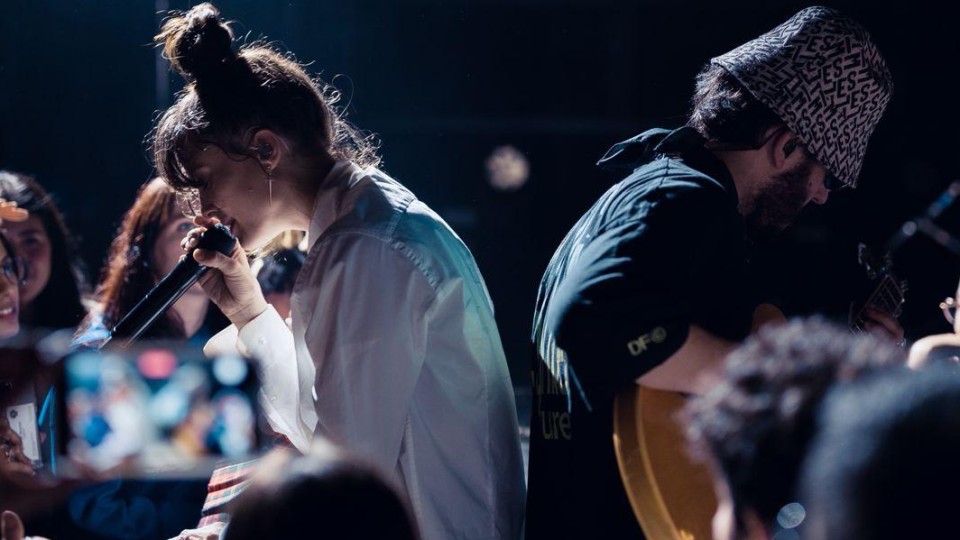
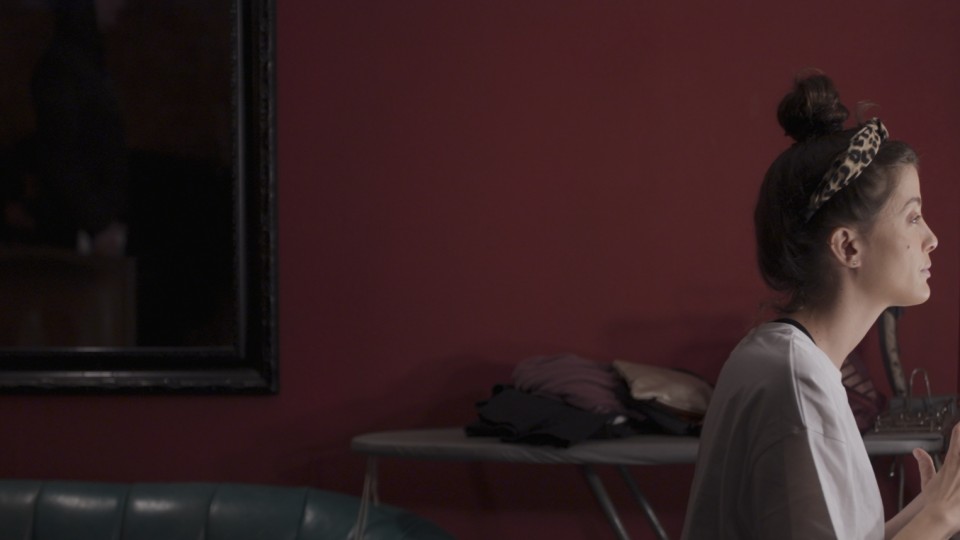
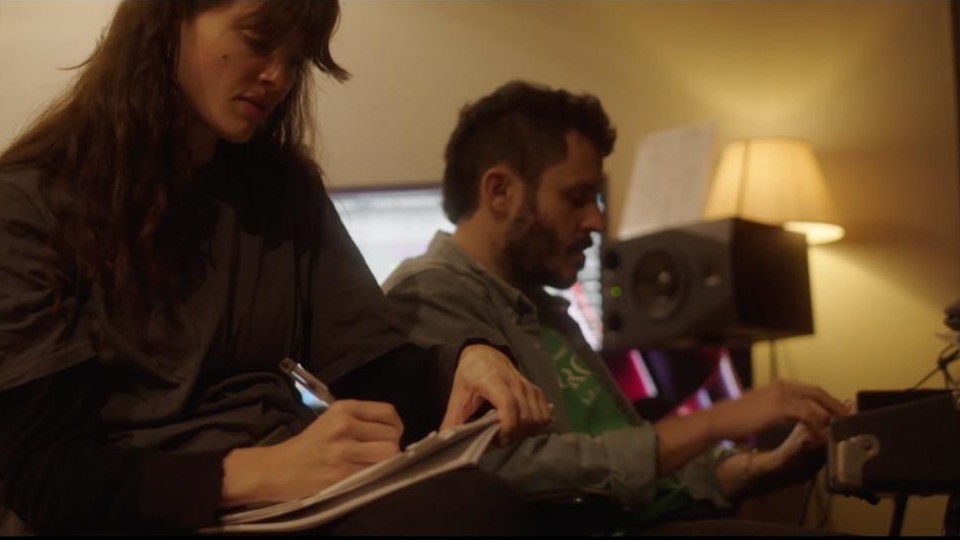
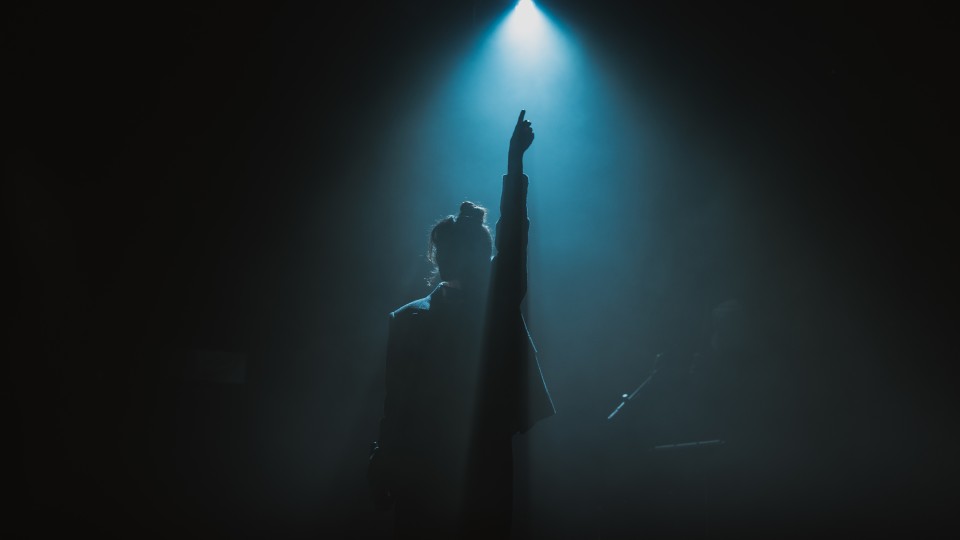
Noga Erez's music is so many things at the same time: with its roots in a range of different genres, it is closely entwined
with her life, her fears, her rage, her vitality, her political stance and, above all, her relationship with Ori Rousso, her
partner on stage and in her heart. Fascinated by the tension between creative drive and emotional ambivalence, the filmmakers
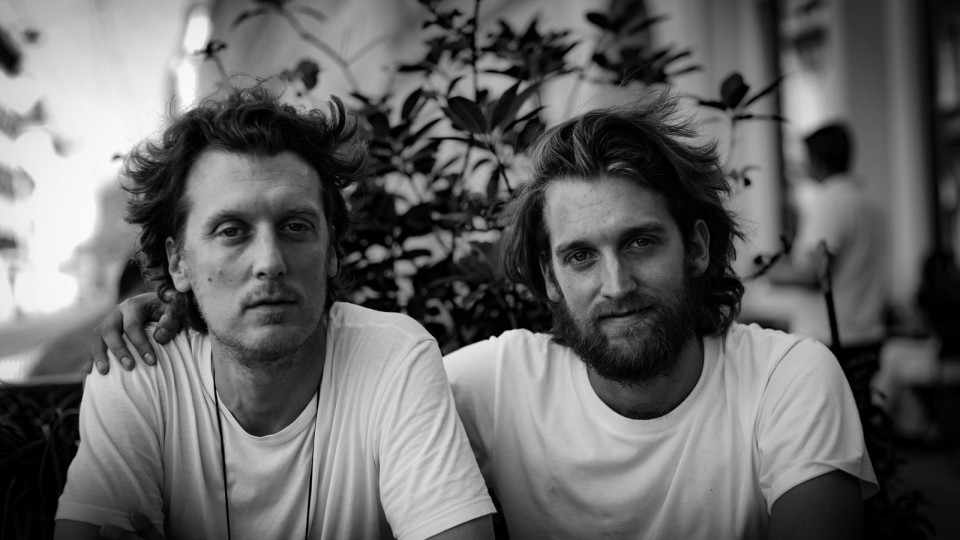
Benji & Jono Bergmann observed the vibrant duo from Israel and accompanied them during an eventful period of their lives;
in the hail of international politics, their film portrait NOGA reveals a sensitive space between the private and the political.
Where was Noga Erez in her career when the film project began to take shape? What sparked your interest in this musician?
JONO BERGMANN: She had just released her album KIDS and there was a real sense that she was on the brink of international stardom. What
fascinated us were two things. First, her music – the force, intelligence, and contradictions in it. And second, her relationship
with Ori Rousso: the way career, love and life were all tied together in one wonderful, complex matrix. That felt like a strong
cinematic starting point to us.
How can Noga’s music be characterized?
BENJI BERGMANN: It can’t be characterized, really. It’s genre bending at its best – a mix of electronic, alternative pop, hip hop and spoken
word. For us as filmmakers, what struck us were the thematic and tonal contradictions in it: dance music haunted by death,
songs that are both sensual and political, playful and angry, vulnerable and confrontational at the same time.
JONO BERGMANN: You could call it pop poetry.
Your range of work in documentary film is very diverse. It includes investigative pieces like Wirecard, animated documentaries
like Camp Confidential and portraits. Following the film about Bruce Mau, NOGA is your second portrait of an artist. What
do you find appealing and challenging about this genre?
BENJI BERGMANN: The truth about making a doc about an artist is that it is almost impossible to get it right. You are always either too near
or too far away from your subject. You have to get very close to a person in order to earn their trust, to be present in vulnerable
or revealing moments. At the same time, you have to maintain a clear separation between the person and the work. A constant
dance between proximity and distance.
JONO BERGMANN: Ultimately, the film can never simply become the artist’s version of themselves, nor can it pretend to be some complete objective
truth. It has to be a film about them – shaped by our perspective, our interpretation, our emotional and cinematic reading of who they are at this particular moment.
How did Noga and Ori Rousso feel about the idea of a film? Were they sure they wanted to have a film made about themselves?
JONO BERGMANN: We were all not sure in the beginning. I don’t want to speak for Noga and Ori, but I think it is always difficult to understand
what about your own life is cinematic. What is relevant, what is too private, what is ordinary only to you but fascinating
to others, what belongs in a film and what does not. That is where we come in.
BENJI BERGMANN: And maybe that question gets even more complicated when you are an artist yourself, because you are used to being in control.
You are the one that shapes how things are seen and heard. So there also had to be a real act of trust on their part – to
let go and let someone else look, interpret, and eventually create something about you.
Can you tell me about your first meeting?
JONO BERGMANN: The four of us met in 2021– Noga and Ori, Benji and I – two different duos, so to speak. We started filming a few days later.
In essence, there were two starting points: one when we started exploring and first pressed record, the other was when we
all decided to make the film. That moment was when Noga and Ori let us in on a secret that only their families knew. Not
even their band members. They had decided to put their relationship on hold and separate their love life from their work.
BENJI BERGMANN: With portraits, there’s always the option to go to the very beginning. To delve into Noga’s childhood, for example, and tell
the story of her entire life up to this point. We found it more interesting to approach it as a slice of life. Using verité
to observe a young, artistic duo in the act of becoming. And therefore it was very important to us to try to make a film using
only the footage we shot. We enter the story with how we meet Noga, and we exit with how we left her. That makes it a specific
document in time.
How did you try to balance the different aspects of the portrait: Noga the musician, Noga the politically committed artist,
and Noga the private person who lives in a relationship with Ori Rousso?
BENJI BERGMANN: It’s all three. Together. At the same time. Life is goulash. It’s not potatoes, meat, and onions. We pick apart ingredients
as observers, try to make sense of them individually, but in life they are mixed into one thing, constantly complicating each
other. Which ingredient you focus on as a viewer is your choice and dependent on who you are at that given moment.
Did the release of the album KIDS mark the start of filming in 2021? How often were filming blocks scheduled?
JONO BERGMANN: The starting point was in 2021, documenting the twists and turns in that rocky phase of their relationship. And we then never
stopped shooting for five years. Over time, this created an enormous archive: concert footage, tour material, studio and private
moments, political turmoil and additional material shot across different periods. In the end, we had thousands of hours of
footage...
which we then worked through over more than a year with our brilliant editor, Yonatan Weinstein.
The film is structured around the album titles and in an A and B sequence. Can you explain this structure? Does the film also
document the band’s musical evolution?
BENJI BERGMANN: Each one of the chapters in the film is named after one of their songs. Noga and Ori work through their lives, their fears,
their wounds through their music. And as such, each of these chapter titles signify more than the song. It is a moment they
tackle with the instruments they have.
JONO BERGMANN: Life influences the music, and in turn the work that is produced bleeds back into life and changes its trajectory. The personal
and political nature of these songs mixed with the abstraction of the lyrics gave us the idea of structuring the film almost
like a “documentary album.” And so yes, the film does document a (musical) evolution, but not in a linear way. Like on a vinyl
record, there is an A-side and a B-side, and a turning point occurs in the film right in between.
BENJI BERGMANN: And by the way, one of the chapter titles is not one of Noga’s songs. It is someone else’s song she turned to, to make sense
of the moment she was in
a moment where it was too difficult for her to make her own music.
Documentaries are a tightrope walk between the predictable and the unpredictable; this film seems to have been pushed to
its limits in that regard. How did you perceive this journey?
JONO BERGMANN: Hitchcock I believe said – in feature films, the director is God. And in documentary films God is the director.
BENJI BERGMANN: With all due respect to Hitchcock, I disagree
Every single frame in every single documentary is a decision.
After such a long journey, how do you know when the time has come to bring it to a close?
JONO BERGMANN: There were many beginnings and many endings. But that is the nature of documentary: at some point you are forced to or you
choose to abandon it. Otherwise you could go on forever. And that point is different in every film. In this case it was a
day we shot with Noga and Ori that ended up being the final, closing image of the film. It’s not something I can explain rationally;
it was a gut feeling. That our particular journey with Noga had come to an end.
BENJI BERGMANN: At the beginning of the film, Noga says that the next three to five years will determine the rest of her life. I think we
all do that at different stages of our lives. At the end of the film (and five years later), there’s a moment when she – and
the audience – realize that this isn’t actually true. She’ll look ahead another three to five years and ask herself again
where she’ll be then.
How did the couple come to be so open about their personal issues in front of the camera? How did you, as the film crew, find
your place? How could you achieve this level of intimacy?
JONO BERGMANN: That openness was there from the beginning but took years to build. We worked with a tiny crew, with people Noga and Ori
could genuinely trust. A key part of that was our Director of Photography, Roei Morad, who had not worked in documentary before,
but brought enormous passion, a lot of time, and a very precise eye. The approach we developed together helped us find a way
of filming that was non-intrusive, but still cinematic.
BENJI BERGMANN: So the intimacy did not come from pushing harder. But by creating a space in which the camera could eventually become an
invisible part of the room. Often we were just very far away from them with the camera, which allowed them a natural space
to be in. I think it's important not to conflate physical proximity to a subject with intimacy.
To what extent did October 7, 2023, upend and redefine the film’s narrative? In the initial phase, what did the physical threat
and the uncertainty mean for the film’s continuation?
BENJI BERGMANN: It changed the trajectory of the lives of everyone involved in the film. But it did not change the filmmaking itself. We
worked hard to stay true to our original approach: a couple processing the highs and lows of their lives through music and
that music in turn, changing their lives.
When did the first concert cancellations begin? Does Noga’s experience – being boycotted because of her nationality rather
than her political views – particularly highlight the sensitive issue of boycotts?
JONO BERGMANN: You’d have to ask Noga the precise starting point, but the first cancellations we were made aware of were in late 2023. At
first, it was often not explicit. Sometimes it came through vague language, logistical or security concerns, or suddenly shifting
circumstances. Later it became more explicit.
And yes, in Noga’s case the questions surrounding cultural boycotts are brought
into a very sharp and particular focus. She is known in Israel as being a government-critical artist, yet she finds herself
judged not primarily by what she says or believes abroad, but by her nationality. That is what makes it so uncomfortable and
revealing. The boycott in this case stops being a clear political tool and becomes something much more blunt.
The decision to have a child comes at a time of extreme uncertainty. Is the fearlessness with which Noga attends demonstrations,
plays songs with provocative lyrics, performs while pregnant, and chooses to have a child at that very moment something that
particularly fascinates you about her?
BENJI BERGMANN: I think I know what you are asking. There is a sequence of lyrics in Noga’s song The Vandalist that describes this best:
So I sleep with one eye open.
My heart is always broken.
My shoes are always walking.
JONO BERGMANN: I think that spirit is one of the traits that drew us to her and her story from the very beginning. There is an unpredictability
in the way Noga approaches her music and in the same way there is a lot of unpredictability in her life. Documenting this
has been a fascinating journey as filmmakers to remain open every day to reshape our own trajectory.
Where does Noga's musical career stand now, a good year and a half after the last shoot?
JONO BERGMANN: She is writing the next chapter, quite literally. Noga and Ori are still making music, working on their fourth album, while
navigating the beautiful chaos of life as new parents and co-working artists. We have several unreleased, original songs in
the film. Some of these might make it into the next album. Let’s see.
In the film, an interesting dynamic emerges in which you, as a directing duo and brothers, portray a musical duo who are
also a couple. Even though sibling and partner relationships aren’t directly comparable, did this dual dynamic nevertheless
draw a connection to your own work and raise questions about artistic processes and their development – questions that you,
as brothers, also face?
BENJI BERGMANN: From the very beginning, I think that subconsciously we were drawn to documenting their work as a couple. They let us enter
their creative space, and over the years we were able to see how they work. We saw a lot of ways in which they are different
from us, and ways in which they are similar to us. The relationship between love, partnership and artistry are central to
this film. So, in that regard, it's also a very personal film.
JONO BERGMANN: The personal and private blend with the professional; and we see Noga and Ori in the film try – in vain – to separate them.
I think in artistic creation, it’s impossible to say, “Here are Benji and I– the brothers,” or “Here are Benji and I – the
co-directors.” We’re often asked who does what and how we split up our work. We have a stock answer for that, but in the end
it’s always different, always new. Often you can’t explain what one of us does and what the other does, and why. We started
working together ten years ago. It was a little different with every film.
And you’re still working together
...
JONO BERGMANN: Yes
and we enjoy it.
BENJI BERGMANN: Most of the time.
(Both laugh)
Interview: Karin Schiefer
May 2026