It gets dark on Earth whenever the moon obscures our view of the sun. And at the same time, this unusual configuration very
briefly reveals things to the naked eye that would otherwise remain hidden. The filmmaker Manuel Wetscher has taken inspiration
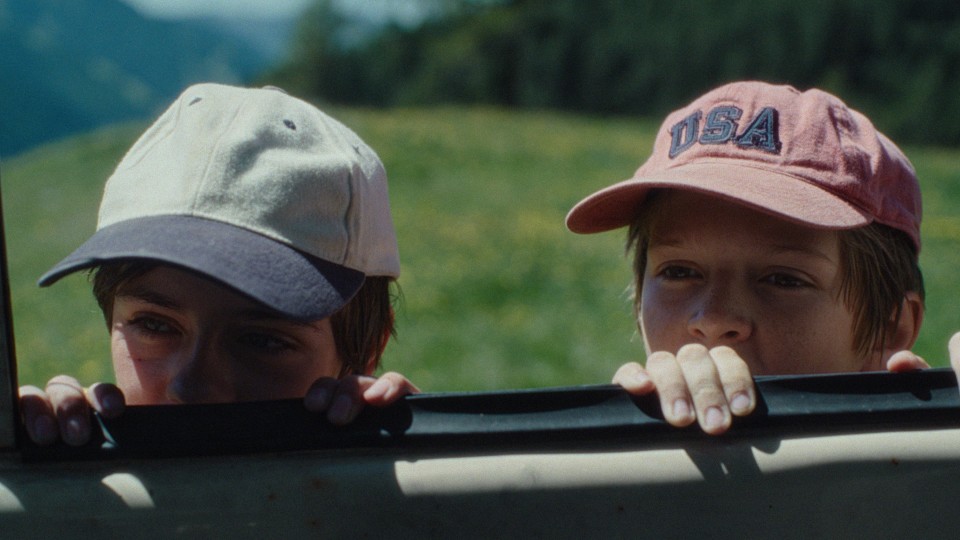
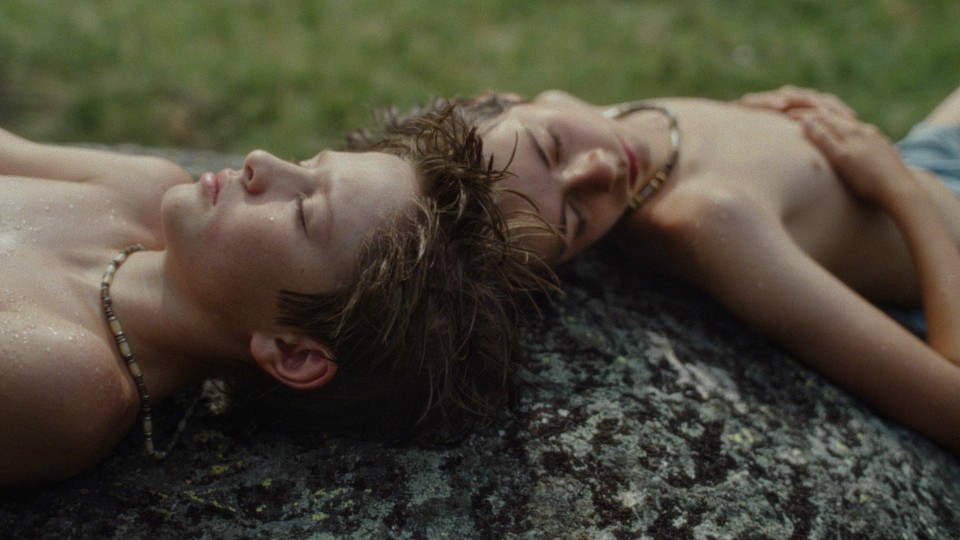
from the phenomenon of the total solar eclipse to cast his light today, in his debut film EKLIPSE, on the death of his father from AIDS back in the 90s. A summer holiday that two teenagers spend in a little Tyrolean mountain
valley becomes a depiction of the ways that ignorance, fears and taboos can obscure a clear view of important truths.
Was the autobiographical dimension of EKLIPSE an element of the material from the beginning?
MANUEL WETSCHER: The autobiographical aspect, which is very closely related to my father's death from AIDS in 1993, was an impulse from the
beginning. On top of that, when I was a teenager I spent many summers with my grandfather on an Alm, a mountain pasture (including
the summer of 1999, when there was a total eclipse of the sun). Detaching myself from my own experiences was a long process.
The deeper we delved, the more we realized that we could whittle down the material and portray a lot of it through conflicts
between the two boys. My co-author Bernhard Jarosch and I have been friends for many years. This trust, and the fact that
we know each other so well, was extremely important in fictionalizing the autobiographical story.
EKLIPSE also evokes associations with films by Clara Simón, who is from the same generation, and parallels in terms of subject
matter can also be discerned. During the course of your work, did you become aware of the collective aspect of these experiences
with the AIDS deaths of close relatives?
MANUEL WETSCHER: I didn’t encounter Clara Simón until very late on, and I think what she does is great. But I also find it fascinating to
see the different approaches we apply in negotiating the subject. I think it was really only via art that I gained access
to my personal experience. One exhibition that woke me up with a jolt, so to speak, was United by AIDS in Zurich in 2019,
which featured artistic and political works created in the 90s, at the height of the AIDS crisis. They brought it home to
me how crucial it is to make the issue visible, and to talk about it. I myself didn't know for over ten years that my father
had died of AIDS. By means of this critical engagement, I began to appreciate the wider social context. I was able to understand
that my perceptions as a child weren’t individual experiences; they were powerfully influenced by external mechanisms. In
EKLIPSE, we wanted to portray in detail how ignorance about a disease triggers stigmatization and discrimination.
EKLIPSE refers to the phenomenon of a total solar eclipse, when an object briefly blocks our direct view of things, and darkening
is the result. However, eclipse is also a term from virology. What thoughts led you to adopt this title?
MANUEL WETSCHER: The image of a solar eclipse accompanied us as a dramaturgical principle right up to the editing: When is something visible?
When is something covered by something else? When does something else come to light? After all, at the moment of a total solar
eclipse, the corona becomes visible; it’s always there, but normally the intense brightness of the sun obscures it. It can
only be perceived by the human eye at this special moment. In this way, something can be presented on a cosmic level that
refers to the small scale. A kind of transference develops between the macrocosm (the social) and the microcosm (the experience
of the two boys). On top of this, the term eclipse is also used in virology to describe the phase when the virus has entered
the body but hasn’t yet infected it. It felt right that the idea of the eclipse continued to develop right through to the
end, and we didn’t just film according to an pre-set model.
A total solar eclipse is a natural phenomenon that also has irrational and spiritual associations. In rural Catholic areas,
AIDS was also regarded as a divine punishment. And today, when we watch a film about AIDS in the 90s, it is through the filter
of the collective pandemic experience. Was it important to you to make this analogy tangible?
MANUEL WETSCHER: I believe everyone can interpret that question for themselves. We were writing the screenplay on an Alm in Tyrol during a
late phase of the pandemic. There were still a large number of restrictions. In that respect, we felt the immediate impact,
and we could see it. I believe the Covid experience creates a way for audiences to appreciate the fears that the film refers
to. I was also helped by conversations with older members of the crew who had known people who had contracted AIDS or died
from it during the first phase. That enabled me to see my childhood experiences in a different way, and to better understand
how things were in groups of friends, families and the hospitals. And how politicians acted, especially in Christian-social
parties: the vocabulary and the fantasies they employed at that time.
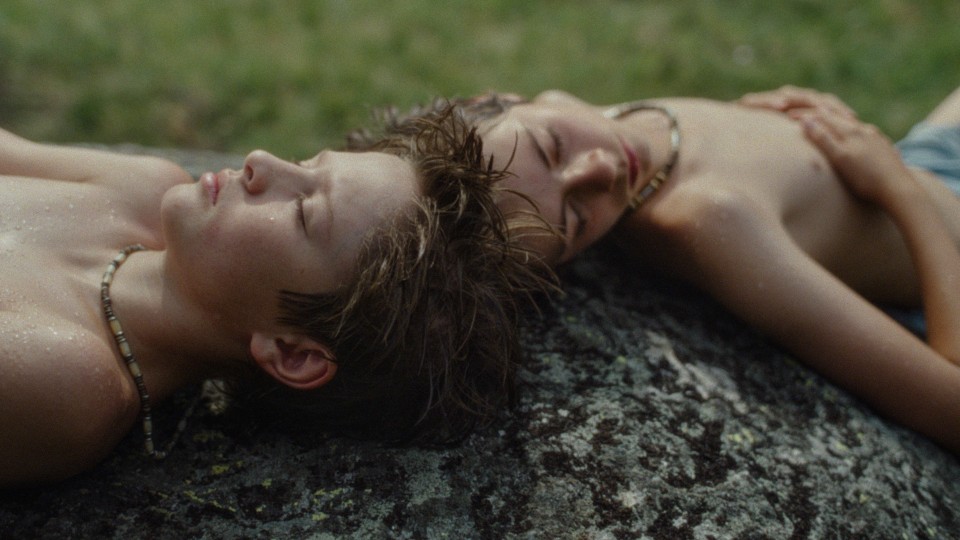
The visual language depicts a lot of things by using close-ups of nature, with a slow pace that seems to owe a lot to the
analogue era. What was the starting point for the camera concept that you developed with Simone Hart?
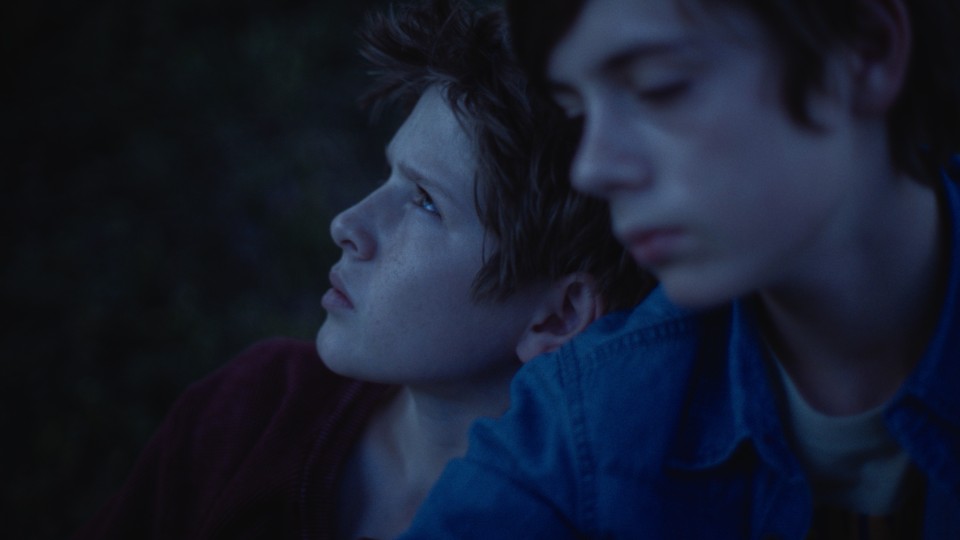
MANUEL WETSCHER: The idea of an interplay between macrocosm and microcosm was already set out in the script. Using so many close-ups like this
creates a reference to the friendship between the two boys, placing us in their situation in a haptic sense. Finding a form
that allows us to engage with a world is what interests me about the cinema. The immersive moment was a driving force for
Simone and me. This approach led to the selection of lenses – they are photojournalist Nikon lenses from the 80s. And then
we were faced with the question of which perspective to use for the narrative. Sure, we wanted to be with the boys, but sometimes
we, the audience, know more than the characters do. Simone was familiar with country life from summer holidays during her
childhood. And there were cinematic references to films by Bruno Dumont and Alain Guiraudie, who do a lot of work in rural
areas. For the Alm location, we wanted a place that was fully operational, which we could "attach" ourselves to on film. We
had already tried in the screenplay to locate narrative elements in work processes and routines that are found on the Alm.
Cow by Andrea Arnold, which tells the story from the perspective of a dairy cow, was a film that made it clear to us which
direction we wanted to take.
What prompted you to shoot the dialogue in Tyrolean dialect? What consequences did this decision have for the casting?
MANUEL WETSCHER: We felt it was important that our cast had grown up in this cultural area, or had some link to it, so there’d be a plausible
linguistic flavour running through the entire ensemble. Apart from the actors playing the younger versions of the two main
characters, they’re all professionals. It wasn’t clear whether getting so close to the cows would be a problem for our cast.
It's not easy to move through a barn with 40 or 50 cows. We found someone in the Alpachtal Valley who runs an Alm and did
a great deal to make things work for us. We needed a person who would be patient, show an understanding for artistic processes
and procedures, and also be prepared to put up with us during the whole time we were attached to his farm. We had to become
deeply involved in the daily routine there, and it was only by using an almost documentary approach that we could locate our
world in that setting.
It made sense for us to approach Eutopiafilm, which is based in Innsbruck, and work with a lot of people on the crew who come
from Tyrol. I didn't want to use the perspective of an outsider looking in; I wanted to make a film looking outwards from
inside.
You also made a short film with the editor of EKLIPSE, Anna Kirst, entitled Richard, which seems to be part of a wide-ranging artistic process.
MANUEL WETSCHER: When Richard premiered in 2024, we were already mid-way through project development for EKLIPSE. In fact, there were times when the feature
film project seemed on the verge of collapsing, due to financing. But by then I was so deeply involved in the work on Richard,
and I really felt the need to complete it. I didn't want to be left with the fragments of that short film if the feature film
couldn’t be financed. Completing Richard was a small step towards asserting my independence of funding decisions. I felt the
very strong need to pursue these questions and get the film to the stage where I could present it to the outside world. And
working on Richard with Anna was a valuable preparation for EKLIPSE.
At the end of Richard you establish a dialogue between video footage from your early childhood and phone pictures of your daughter. Perhaps very
early childhood, which is only accessible through the gaze of other people, is also a kind of eclipse. Is EKLIPSE perhaps
also an attempt to (re)master one's own perspective on one's own childhood?
MANUEL WETSCHER: That's a fine thought. It is only possible to look back and see certain things from a certain distance. I use images of myself
in the film that are from a time I can't consciously remember. Not because my motivation is to share photos of my childhood;
in both works I contextualize them afresh, perceiving them as material I can use to create new contexts. For me, painting
and photography always have something to do with perspective. How can you represent something so you establish a different
perspective on something that has always been there? Perhaps the images are tools to activate something which was there previously
but which you couldn’t perceive before. In the film, my own material becomes the childhood memory of our main character, Tomy,
and through these images he comprehends something that we always wrote and named in the script, but without having an image
for it. In the editing process, we discovered how images from completely different contexts can be linked together. Suddenly,
the solution was very clear and simple.
Interview: Karin Schiefer
July 2026
Translation: Charles Osborne