It dawned on Rose at an early age that if you want to lead an independent life, with access to education and property, you
would do well to be a man – or at least, to wear pants. In the century of the Thirty Years' War, this young woman chooses
the path of disguise and has considerable success. She doesn’t realize until it’s too late that the village will demand a
high price from her for this "betrayal" of their community. As meticulous as a historical novel, as timely as a sharp-eyed
look at the present, Markus Schleinzer's ROSE speaks to us of fundamental inequality, of the courage to attain freedom and of the ever-present walls that society erects
to exclude those who are different.
Like Angelo before it, the action of ROSE takes place in a previous century. Does the historical context help us to perceive more accurately
the unresolved problems of the present?
MARKUS SCHLEINZER: I believe that a historical setting works like a magnifying glass. When you take an audience into the past, they apply fewer
filters and preconceptions. The problem with the present is always that you can’t comprehend it, because you don’t yet have
a clear overview. Personal freedom, for example, is being used today by all political camps to advance their own policies.
In the historical material that underpins ROSE, I encountered many things that couldn’t be discussed or experienced much better
today than in that different era.
In contrast to Angelo, Rose is a fictitious character, even though it would be possible to get the impression that this is
a historical case. Where and how did you explore Rose's context?
MARKUS SCHLEINZER: I never look for a theme. Things have always been washed ashore, so to speak. ROSE had its roots in a coincidence and a comment
from a female historian. I did some research and unearthed about 300 stories of women who, over about three centuries, chose
"the path of the pants", for a wide variety of reasons. They were prompted by a whole host of factors: easier access to work,
the need to escape war or criminal activity, the hope of avoiding rape or forced marriages, the yearning for a life with more
personal freedom, lesbian desire, transsexuality, patriotism, exoticism. The crucial point in telling this story was that
all of those motives, despite being highly individual, were ultimately based on one thing: the awareness that freedom and
opportunity were severely limited for a woman.
Your screenplay is rooted in prose. How do you find your way into the language of the era you are depicting?
MARKUS SCHLEINZER: I have no idea whether the language in the film corresponds to the period. My co-author Alexander Brom and I felt it was
important to write something that asserts a self-contained universe. I think that's the trick to any kind of historical film.
It's not about striving for a museum effect, which is ultimately boring. None of us were there at the time. A lot has been
lost, so we don't know. It’s much more important to create a universe. I read historical texts in order to put together a
vocabulary of some sort, to clear my head of young people’s idioms and Anglicisms, so I could appreciate the rhythm, the feeling
for the language, the approach to tenses and syntax. The original ROSE package is over 1000 pages long.
Why is there an unseen female narrator?
MARKUS SCHLEINZER: The narrative voice came out of the prose writing. I thought it was interesting, right from the start, to have a non-judgmental
external voice that accompanies me, opens up spaces and yet allows me to perform my own analysis. It represents storytelling
itself, the sovereignty of narration, which is always the most important thing, after all. It was an attempt to film a piece
of German literature in a form that conveys the impression that it already exists, as if it were a film adaptation of a novel.
It strikes me that in terms of the question of freedom and the place of the individual in society, there’s a second echo of
Angelo. Is the tension between the needs of the self and the norms of others the determining factor in your approach to cinematic
narrative?
MARKUS SCHLEINZER: I’d say that my three films, Michael, Angelo and ROSE, strive towards this theme in a variety of ways. Rose isn’t a revolutionary.
She isn’t inspired by a social concept, she doesn’t want to set an example so things will be better for future generations.
She takes this step for selfish reasons – because she doesn’t want to live as a woman under these conditions. She isn’t a
revolutionary, but her actions are revolutionary. Rose is manipulative; she lies and cheats. The most touching moment in the
film for me is when she realizes in the end that she has ruined another person’s life as well by wanting to live her way.
That’s a shock for her, and it’s shocking. I think that's how we all have to live in society each day. It has become fashionable
to say you should pay more attention to empathy. I think empathy is fine, but I also think we have to pay more attention to
the responsibility we have with and to and for each other. I don't have to like everyone, but I do have to acknowledge that
there are codes, and I have a responsibility as another human being. In everything I do, I am committed to dialectics. In
dialectical coexistence, dissent must also be allowed. The culture of debate has been lost.
It is impressive how Rose, when she is completely cornered, defends herself in a powerful speech and stands by herself and
her decision.
MARKUS SCHLEINZER: When she’s ambushed by the mob outside her house, it's a Frankenstein moment: they want to see the monster. They’re motivated
by voyeurism, the need to destroy the other, the deviant. I deliberately didn't give the mob the big moment. It was more important
for me to represent a person who says, as Rose does in the film: "Yes, maybe I don't have a dick between my legs, but because
I'm here, you benefit from it, and so do you...". She lists the things that have become better for this community. But still,
stupidity and fanaticism prevail. That's why I wanted to give my Rose character the stronger voice. Whether or not she’s a
lesbian isn’t interesting; that would reduce the stature of the film. Her motivation in putting on a pair of pants is purely
private, and I completely leave that to my character. What’s more interesting is what can result from it.
We also sense what it means to carry such a big lie with you for so long. The conversation between the spouses brings relief
and understanding. Does the suggestion of a possible utopia pop up briefly here?
MARKUS SCHLEINZER: A lot of queer people say that socialization or growing up was so hard because initially they had to live with a false identity.
You can never relish all your power, because you need so much of it to maintain the disguise. The moment you can reveal yourself,
and sometimes find acceptance, you feel freedom for the first time. That's why I thought it was important to extend the whole
thing to a utopian continuation, when the two of them flee. We experience them as a quasi holy family in the forest, where
they build a nest together. They both play utopia here. On the one hand, it is almost the re-enactment of a painting; on the
other, by not responding to the fact that it’s cold and raining, they are already enacting a form of abstraction before the
film goes back to reality.
Sandra Hüller was the actress you had in mind while you were writing, before she was actually on board. What does she embody
for you as an actress?
MARKUS SCHLEINZER: It’s quite clear and irrefutable: there’s this enormous talent, a compelling logic, coupled with extreme honesty and lack
of vanity in her performance. ROSE is also a political film, and I was looking for a person who could carry it politically.
We know the film industry is still full of all the "-isms", and I don't just mean ageism but also sexism. Then she shines
through. Because she has never contorted or ingratiated herself in that sense. When we were in the deepest Harz Mountains,
two lonely Austrians on location search, and we were asked: Who are you? And what are you doing here?, and I told them we
were making a feature film with Sandra Hüller, it was obvious that she was known in the back room of the most remote inn.
ROSE is a film that practices maximum restraint. No visible unmasking of Rose's body, no violence, no flashbacks to Rose's
former life.
MARKUS SCHLEINZER: The effects of violence must be addressed, but violence in film shouldn’t be graphic.I've seen so many movies where women
are raped. I don't need to see more. At the same time, it would be wrong not to tell it. But images come with a responsibility,
and we have a serious obligation to respect that responsibility. I've watched a lot of films about crossdressers, and the
nonsensical thing is that the unmasking is invariably depicted via the body. To this day, it's mainly because that’s somehow
titillating. I don’t go along with that. Rose's story works flawlessly without the revelation of her naked body.
ROSE moves between identities and polarities. Did these tensions also contribute to the decision to work in a reduced, black
& white palette?
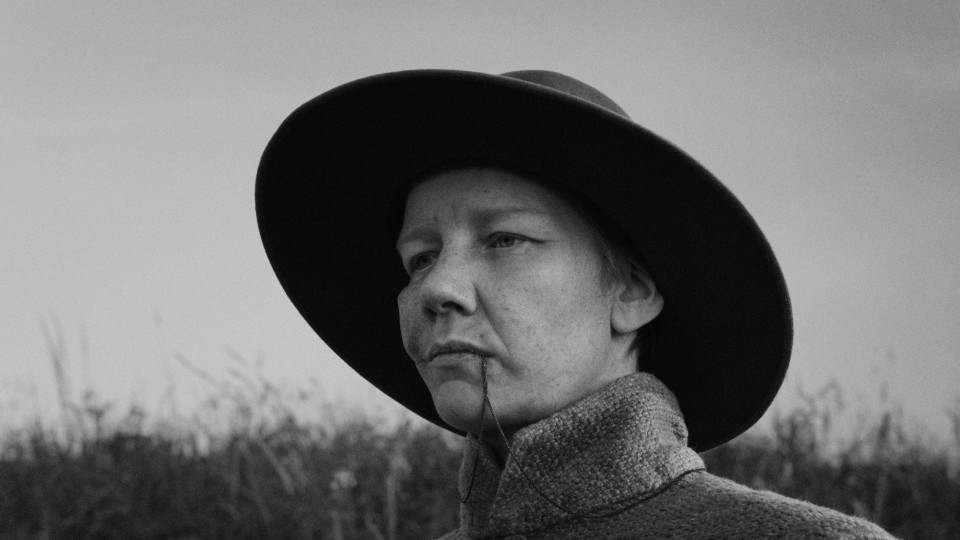
MARKUS SCHLEINZER: People like to watch historical films because the use of color is so beautiful. With ROSE, I thought it was interesting to
dispense with that, because it means that the story has to work more strongly for itself. In cinematic terms, working with
black & white means you have to deal with colors and color contrasts in a completely different way. Black & white operates
very strongly through light: light and dark. Every face becomes a landscape, and you have to work a lot with structures and
surfaces. There’s something more archaic about it.
How do you tie all this together with the present? Being different seems easier but still means being threatened. What do
you perceive as the reasons for society's rejection of the other?
MARKUS SCHLEINZER: In particular with relation to the violence inflicted on her character, there was a lot of discussion about this with Sandra
Hüller. I think for a while she’d have preferred us to make a film that creates a beacon which people can flock to. But I'm
not that kind of filmmaker. I think it's important that there are role models, because I don't think we're all especially
brave. That's why I think it's important that we can see something that others exemplify for us. What I often criticize about
films like that is their claim to provide salvation. I’m not like that; I'm not an advocate of salvation. I'm an advocate
of work. It is quite hard for us to find a peaceful outcome here. Imagining that we will be saved from each other by sitting
around, waiting, praying a little and hoping is childish. We have to work on it.
Interview: Karin Schiefer
January 2026
Translation: Charles Osborne