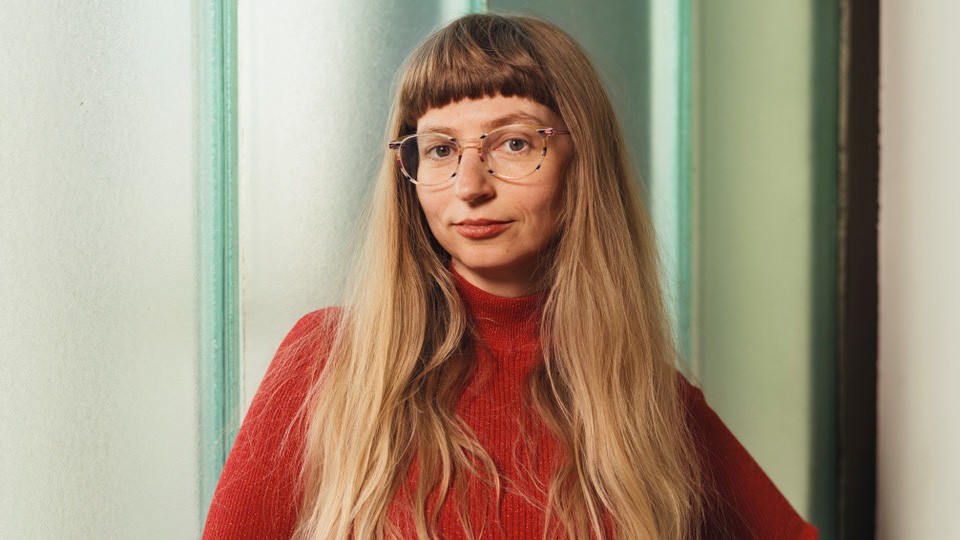
Rosa Friedrich is many things in MY FRIEND THE PORNSTAR: friend, protagonist, casting director, filmmaker, adventurer, researcher – the latter largely because in this hybrid documentary
she ventures into numerous border zones. Prompted by her friend’s intimate desire, she plunges into a risky cinematic project,
touches on a taboo zone of film production, experiments with AI and identity, and reflects on the power and responsibility
associated with her position behind the camera.
Its place in the hybrid documentary genre is only one facet of MY FRIEND THE PORN STAR, which explores a whole range of border
issues. It is a film that questions many aspects of filming – and of being filmed. Was the idea of probing the boundaries
of this medium a basic theme of this film?
ROSA FRIEDRICH: The idea of making a hybrid film was there at a very early stage. Exploring the boundaries of the documentary form was less
a theoretical concept than a consequence of the material. After all, the film itself is about how people reveal themselves,
stage themselves and change themselves through a camera. So it made sense to me that I shouldn’t try to hide the cinematic
construction I was creating. On top of which, I’m probably not patient enough just to observe a documentary issue for a very
long time and only construct a film from the material afterwards. I think very visually, and being able to structure material
– and intervene dramaturgically – appeals to me a great deal. In any case, when you submit an application for funding, you
have to include a dramaturgical arc in the treatment, and the assumption that’s based on has to be fictional, in the final
analysis. So the idea of continuing that construction and revealing the creative intervention from the very beginning made
sense to me.
We learn from the film that audiences for the porn genre are significantly larger than those for the cinema, and yet one is
celebrated for its glamour while the other is ostracized. Did you intend to push against a taboo area of film production with
MY FRIEND THE PORN STAR?
ROSA FRIEDRICH: No. It's not my style to smash taboos. The numbers really are absurd, though. Adrineh, one of our interviewees in the film,
was an opera singer and now produces porn films. She addresses precisely this contradiction: as a singer she was courted,
as a porn producer she feels scorned. But she’s still the same person. We also sensed, during the financing process, that
we were coming up against some resistance due to the subject matter, and as a result it took longer to finance the film. It's
a difficult issue. But the more something is stigmatized, the harder it becomes to see it clearly, control it and ultimately
improve it. There are very ethical porn film productions and some very artistic approaches. This point is often missed because
porn film is generally regarded as a taboo subject that nobody wants anything to do with. Of course, it has to be admitted
that a lot of things about the sector are wrong. But the specific area we looked at – alternative porn film production – doesn’t
get enough attention. Not very much about it is "bad", except perhaps that the actors can hardly make a living from it, so
they need other jobs to support themselves.
Timo, your protagonist, initially pursues his idea for a film and then abandons it; that could also be the plot of a fictional
work. Where is the line to be drawn between fiction and documentary in MY FRIEND THE PORN STAR, insofar as you are willing
to share that with us?
ROSA FRIEDRICH: In this project, the border between documentary and fiction is very fluid; I’d say it ranges from zero to a hundred. I can't
reveal any more details about that, because the fictional level is also a form of protection for everyone who participated
in the film. In terms of the ratio of realism to orchestration, however, we aren’t very far away from purely documentary projects.
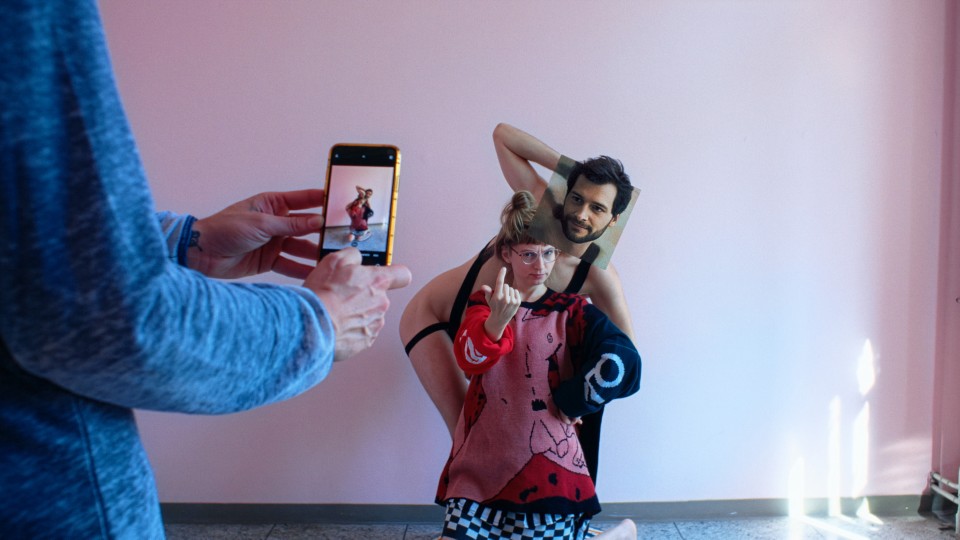
Except that in our case there are also very clearly staged elements, such as the actor Aaron, who provides the face and the
voice for the protagonist. But even there, the boundaries are blurred with reference to whether this dramaturgical trick is
perceived as staged or not. Actually, I’d say you really can believe all the scenes and the protagonists, because even if
something is staged, the ideas for it are taken from observed reality. And in the end, it's more fun to believe something.
Timo wants to be filmed having real sex, because for him, only the presence of the camera as a witness gives the deed genuine
existence. What interested you about this tension between intimacy that you keep to yourself and the need to share it with
the outside?
ROSA FRIEDRICH: It was very touching when Timo revealed to me, during a car ride, that only the media recording of an intimate moment gave
him the feeling it had really taken place. I regard that conversation as a key emotional scene in the film which brings you
very close to the protagonist. It also shows a conflict that was an important starting point for me: the desire to expose
oneself intimately. Coupled with the fear of being judged for precisely that exposed intimacy. I find the simultaneity fascinating:
Timo wants to show us everything about himself – his sexuality and his inner conflicts – and yet he’s afraid of what will
result from that. This contrast means that his desires are always in a state of conflict with his actions, leaving a great
deal as fantasy. And since filming breaks off before it’s completed, we never leave Timo's fantasy of a perfect sex film –
because it never happens.
But Timo isn’t the only character in this film who states that being seen is an essential aspect of their intimate sphere
and sexuality.
ROSA FRIEDRICH: In the film, protagonist Alice Eric Moe says: 'If a tree falls in the forest and nobody sees it, did it actually happen?'
Alice thinks people need the feeling of being seen in order to exist in a real sense. We are social beings, and we need juxtaposition
with others, the reflection of the external, to reassure ourselves of our own existence. We have this need in many areas,
though generally not in the private sphere. Some people, however, also want some form of external confirmation in this area,
from other individuals or society. That's understandable, but it’s a highly individual matter. Particularly when it comes
to intimacy, people have very different ways of setting their boundaries.
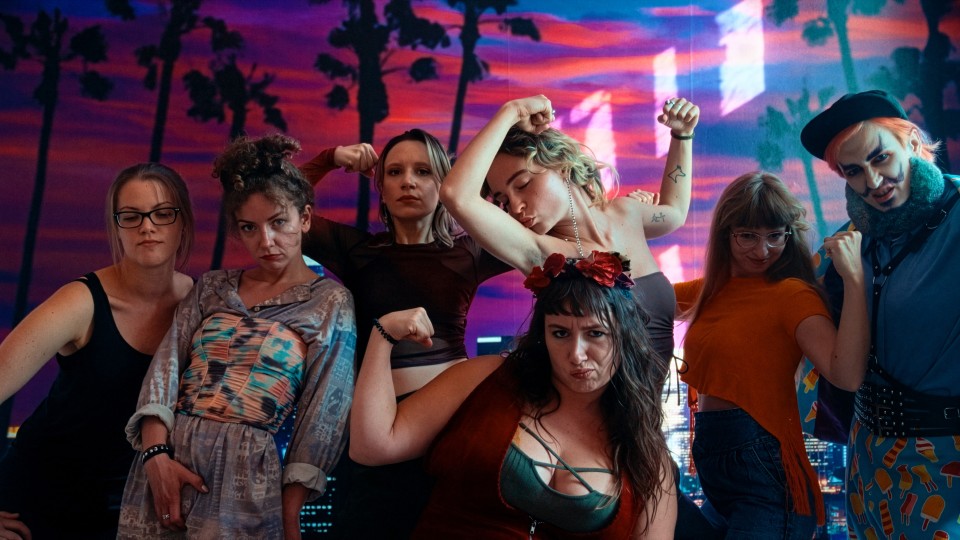
Apart from Timo, you work with a group comprising very different personalities who are perceived as women. At what point did
this group enter the project? What criteria dictated the casting process?
ROSA FRIEDRICH: We started the film with Timo. But the casting process to find a possible film partner for him was an essential dramaturgical
strand from the outset. After Timo's departure, we focused more on the individuals who had previously been the supporting
cast, especially the people we had already encountered during auditions, making them the center of attention. That happened
about two-thirds of the way through filming. I had formulated the original casting call together with Timo: we were looking
for actresses who could imagine being his film partner. We put out this call on various platforms, including dating profiles.
The composition of the group ultimately resulted from all these different processes.
One clearly documentary element of the film is your encounters with people who work in the industry, producing, directing
or acting. You only talk to women. Why?
ROSA FRIEDRICH: One definite reason is that there is a greater awareness of female perspectives here. Alongside that, we wanted to create
a counterbalance to a strongly male-dominated field. Although we did have a very interesting conversation with a male actor
from the alternative sector. That could have demonstrated a possible path for Timo, but at some point in the long editing
process it was dropped. So the film ended up with a strong female presence, even though that wasn’t a premise from the beginning.
I find it interesting that in this way, the film developed in a feminist direction, because the decisions made during a film-making
process always reflect to some extent the mood of the era.
Another borderline area that you touch on in a very interesting way relates to performance: in the gray area you are exploring,
where does it cease to be acting? Where do these actors begin to experience social devaluation and anxieties about serious
consequences for their professional and social life? You also raise the question of what actors will encounter due to AI.
ROSA FRIEDRICH: Actors repeatedly find that their faces are being used to create deepfakes which end up in pornographic material. This applies
to the professional sector, but it can just as easily happen to young people at school, when the faces of classmates can be
used – sometimes with serious consequences, especially for young girls. From a technical point of view, one photo is enough
these days to create a face used in a deepfake. In many cases, once the material has been uploaded, it can never be completely
erased, even if legal action is taken. The younger you are, the more serious it can be. It's a huge problem. I felt it was
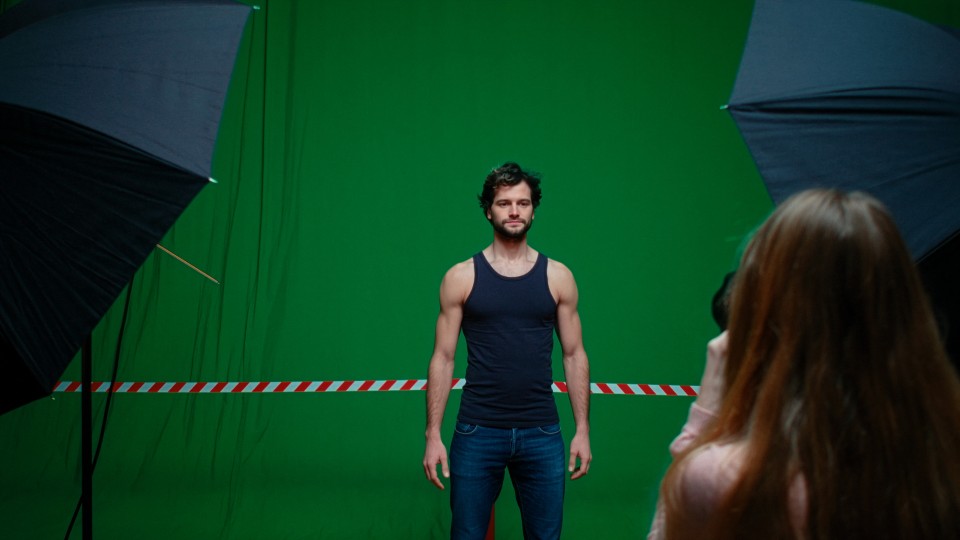
important to raise awareness of this with our obvious deepfake. What Aaron Karl does in MY FRIEND THE PORN STAR, making his
face available to overlay Timo's, is certainly something not every actor would have done. He was very open and bold.
Didn’t anything have to be re-enacted for this deepfake effect?
ROSA FRIEDRICH: It was a special process for us, quite a complicated one, because we wanted to preserve the facial expressions and real emotions
of our protagonist Timo. We extracted footage from the ORF series Walking on Sunshine, which features Aaron, and fed it to
an AI that memorized the different facets of his face and then "factored it” on to our material. So there was no need to re-enact
anything. Aaron only provided us with his face and voice. It's impressive how much AI can already do in this area. In our
case, doing it this way actually saved the project, because we were able to implement it even with our modest financial resources.
We also had a great VFX team who were willing to find quite unorthodox solutions.
Right from the opening titles, there’s a very cheerful, brightly-colored atmosphere, and this doesn’t only characterize this
work on sexuality, in a reference to the queer rainbow: it also represents a powerful expressive force in your other works.
Does your fundamental attitude to color convey a lightness and playfulness which is always part of your storytelling?
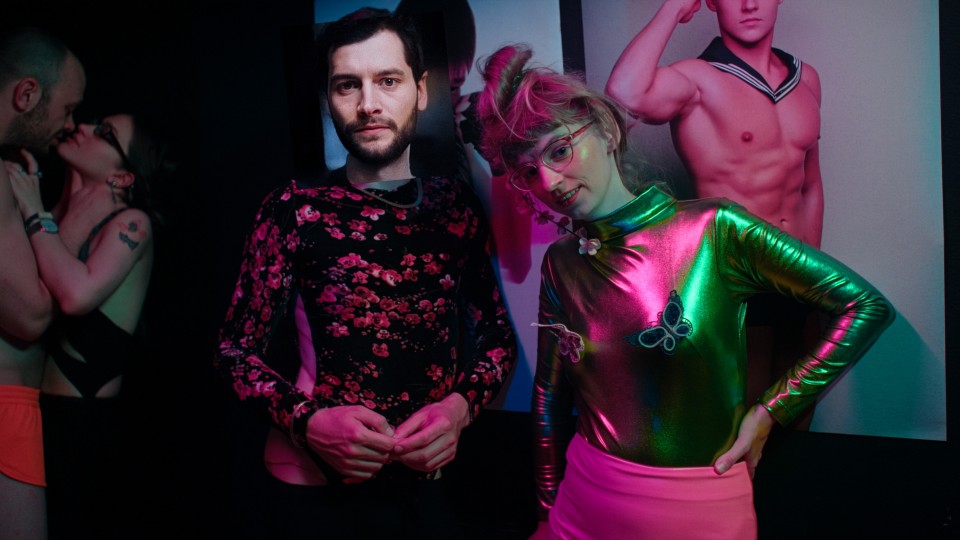
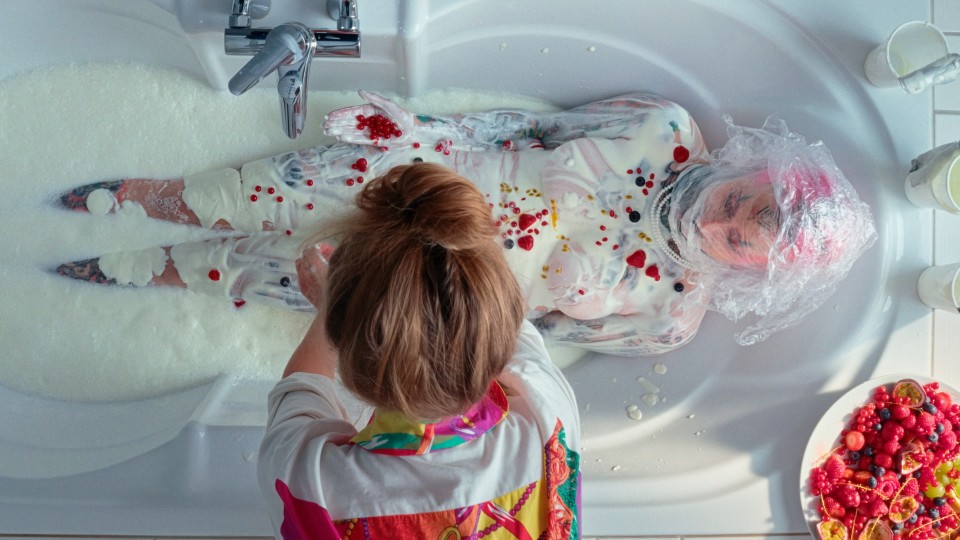
ROSA FRIEDRICH: In MY FRIEND THE PORN STAR, we deliberately focused on bright, cheerful colors, which for me embody joie de vivre and lightness.
We wanted to address a profound and sometimes difficult topic, but at the same time convey that you can approach the film
with a certain lightness. That allows everyone to decide for themselves which aspects will affect them. I myself am quite
sensitive when I watch films, and I appreciate having that option. If I'm confronted with too much profundity and misfortune
right from the start, at some point I can’t take it in anymore. I find that humor creates a certain distance: you aren’t immediately
overwhelmed by emotion, so you can confront a subject with a reflective approach.
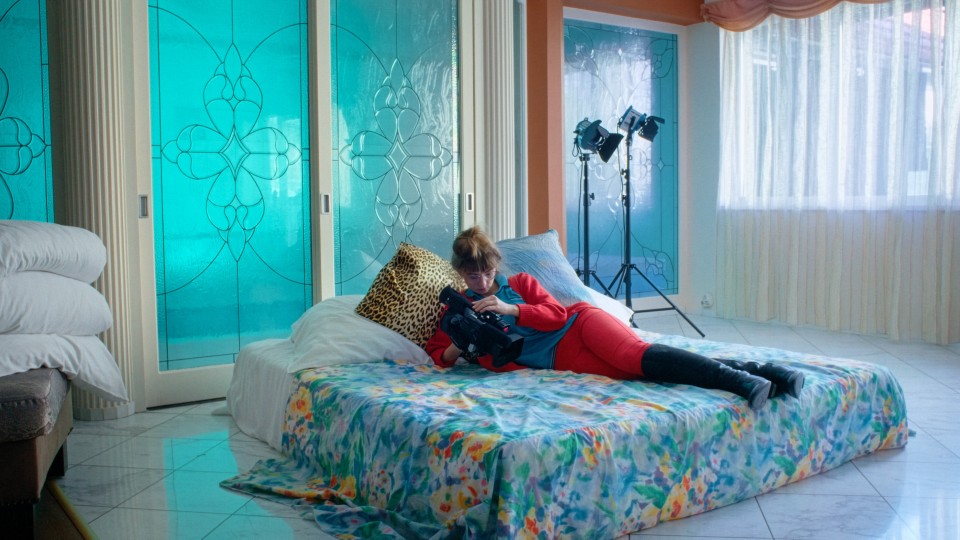
We didn't have a big team, so I put together a lot of the costumes myself. I regarded my own outfits as part of the mise-en-scène
and deliberately chose very colorful items. I generally prefer colorful clothes anyway, but I upped the ante for the film.
After a test shoot, when we didn't yet have anyone to handle design, I was so disillusioned by the images that I realized
we absolutely needed production design, even though our crew was pretty small. For the most part, the design was handled by
Marlene Oberneder, who had a fine understanding of the film’s style. From then on, we were able to design the scenes much
more in accordance with our ideas – and I realized once again how important it is for me that they should have a certain designed
quality.
How intensive was the collaboration with your cinematographer Laura Ettel during this phase?
ROSA FRIEDRICH: Laura had a great sense for the light colors we needed. After the test shoot, we also worked out a clearer camera concept
and looked specifically for large color areas and patterns when choosing locations. That worked well. Over time, we grew together
into a wonderfully well-coordinated team. Working together was a fine experience where it wasn’t necessary to explain very
much at all.
What issues did you have to resolve during editing as a result of Timo's departure?
ROSA FRIEDRICH: Melanie Schmidt, the editor, is a very sensitive person who always considered the welfare of the people in front of the camera.
Figuratively speaking, we always had Timo, his statements and wishes "breathing down our necks", and we asked ourselves what
he would say about each scene. We also arranged a lot of test screenings and watched closely to see what made sense for the
audience and what didn’t, because the film became very multi-facetted as a result of his exit. We became particularly aware
of this when we tried to formulate a logline. We juggled things around for a long time, making the film clearer. After each
test screening, there were fewer questions of comprehension. This method isn’t necessary for every film, but we wanted to
make a film about a sensitive subject laden with taboos, and we didn’t want the audience to tune out immediately, so it was
important to obtain a range of different opinions during the editing phase.
At the world premiere in Karlovy Vary, I realized that the title MY FRIEND THE PORN STAR might create the expectation that
it would be a wide-ranging overview of the industry. But that's not at all what this film is. While we were shooting, and
later in the editing, we were more interested in a small insight into individual stories which are universally applicable,
which I find fascinating precisely because of their simplicity. The "star" in the title is also meant ironically. We emphasized
clearly that Timo and I, as an absolutely amateur couple, approached the whole thing as a kind of buddy comedy – and then
it becomes apparent that it didn’t work out that way at all.
The fact that you yourself are in front of the camera a lot also raises fundamental questions about the role of the director
in documentary filmmaking. In the opening and closing scenes, you address the director's position of power. Did you also want
to demonstrate, in an area which is systemically about male dominance, a reversal of the balance of power?
ROSA FRIEDRICH: The protagonist himself questioned my position of power very emphatically on many occasions. I found that interesting and
addressed it because it’s a very relevant question, especially in documentary films. I know that my intentions aren’t malicious,
but the protagonists can only trust this is the case, at least initially. I decide what is filmed, selected and ultimately
shown. By being in front of the camera myself, I expose myself to this power structure, at least to a certain degree.
Yes, here it's a woman filming a man who wants to expose himself sexually. In this sense, there is certainly a reversal of
the classic gaze. But for me, it was less about simply reversing male dominance than about making my own power and responsibility
visible. There were also concrete safety systems about the filming: for example, all the protagonists were able to view the
film before it was released and comment on it, and Timo’s taboo areas were clearly agreed with him in advance. But no matter
how much you agree in advance, it wasn't easy for Timo to relinquish control over his image. Sure, I can take my own moral
integrity for granted – but ultimately, everyone else has to take it on trust.
You draw attention, especially through the final scene, to the fact that as a director you are also able to use the protagonists...
ROSA FRIEDRICH: I employ that ending very consciously to address this problem, depicting a person in the role of director who crosses more
boundaries than I actually do. I’m also playing a role in the film. My character is more naïve but also cheekier, and more
fluid with regard to boundary lines. I’m sure some people who see the film can’t get their heads around the idea and think
I'm really like that. But I see it as a clear reference to the kind of position of power that a director has, theoretically.
The merging of the private and the professional becomes evident due to the fact that your protagonist is also a friend, but
you also play a director who repeatedly has a camera in her hand while being filmed.Film is revealed as something thrown together.
To what extent was your dual role always connected with the search for the appropriate distance?
ROSA FRIEDRICH: Originally, it wasn't planned that I would be in front of the camera so much; that came about during the process. Finding
the right distance really was difficult, because I was a friend, director and finally also a character in the film – all at
the same time. That's why some of the tensions between Timo and me surfaced in front of the camera, even though we tried not
to let them take center stage too much. In the end, a friendship did actually collapse on this project – maybe not forever,
but at least for the time being.
When Timo left, the professional distance became greater again. That meant filming the last third with the group was much
easier for me and the entire team. I was able to take on my role as a director more clearly again and exclude the private
tensions. Although we created a light, colorful film, the atmosphere during the shooting was often tense. In retrospect, I
believe precisely that friction between personal closeness and the attempt to create professional distance also became part
of the film.
Important experiences that may also have consequences for further projects?
ROSA FRIEDRICH: I learned a lot from this experience, especially about who I wouldn't work with in the future. I now advise my colleagues
almost provocatively never to work with friends. Of course, you can't lump everyone together. But I think friendship doesn't
require as much commitment and dependence as an employment relationship. The nice thing about friendship is that you can move
apart and then get back together. In a working relationship, you must be able to rely on each other, even in a stressful situation.
You get to know people differently. Perhaps it’s comparable to a partnership, where you must be able to rely on each other,
for better or for worse.
Interview: Karin Schiefer
August 2026
Translation: Charles Osborne