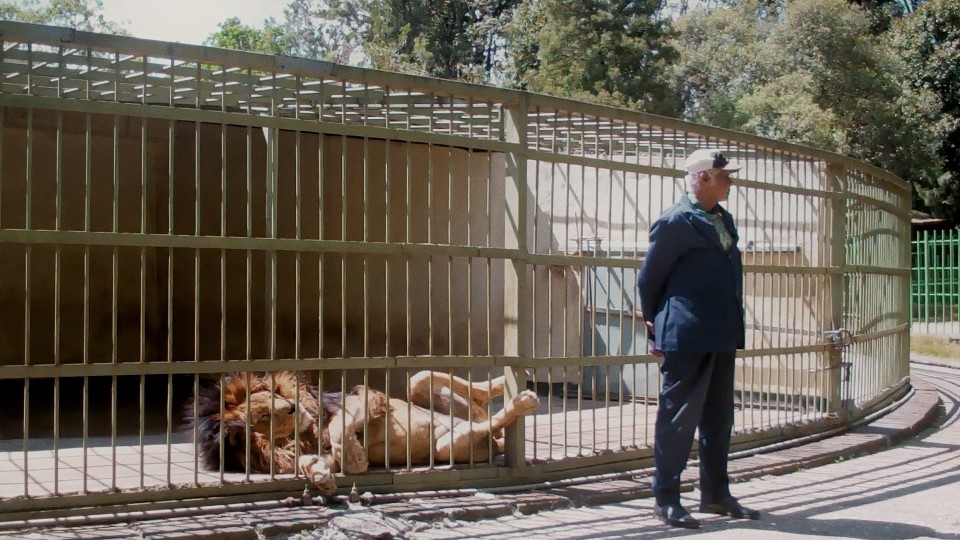
In Ethiopia, the filmmaker comes to realize, everything is different. Not just the calendar; even a classic hotel like the
Hilton in the capital has an unusually strong identity. The legendary Emperor Haile Selassie, as a striking figure in the
media during her childhood, along with Ryszard Kapuściński's successful book The Emperor, as a view of the mechanism of power
he inspired, provided the impetus for the film essay WAX & GOLD. In it, Ruth Beckermann reflects on the relativity of our
(historical) knowledge and on shifts in the perception of the world order, both her own and those outside.
We learn in the film that the expression “wax and gold” refers to the complex ambiguity of the Amharic language, specifically
a particularly idiosyncratic technique whereby a speaker says one thing and actually means the opposite. In the questions
it raises, WAX & GOLD repeatedly explores oppositions – fiction/non-fiction, foreign/familiar, true/false. Did it become a
film that also confronted you with questions about filmmaking per se?
RUTH BECKERMANN: I have already posed these questions for myself in A Fleeting Passage to the Orient, a similar film essay where my narrative
voice plays an important role. WAX & GOLD is also about filmmaking per se, but – more so than before – about the change in
my view of the world. My positioning as a European has changed; the world has become bigger for me. In recent years, I have
been focusing on literature from and about the Global South. Europe no longer has such a central position, and neither does
the USA. There is a shift in the balance of power which I may not yet feel in everyday life, but I do feel very strongly in
my view of the world.
In WAX & GOLD, you also feature as a traveler. In terms of confronting the unknown, are traveling and filmmaking two things
that go hand in hand?
RUTH BECKERMANN: Traveling means being confronted with a lot of questions. Making a film in a different culture does so to an even greater
degree. Ethiopia isn’t comparable to any other African country, to anything I had seen so far. That’s one reason I chose a
hotel as the framework structure: I wanted to present an image of Africa unlike what you usually see in the media. It was
equally important for me to shoot in a place where I felt justified to do so, and safe. The camera always places you in a
position of power, but I didn't want to overdo that. Navigating between the alien and the familiar was the exciting thing.
We know a hotel like the Hilton in Addis Abeba, but not the people you meet there. Everything is different there.
What made this hotel a special place?
RUTH BECKERMANN: In countries like Ethiopia or India, these large hotels are also meeting places for the local middle and upper classes. They
fulfil the function of cafés or pubs. The Hilton is no longer considered a luxury hotel, but it has facilities: there is electricity,
good Internet and a fantastic pool with water from a hot spring. There is a swimming club with 800 members. You meet a lot
of people there who live in Addis, there are weddings, fashion shows; there’s something going on almost every day. The hotel
was founded by Haile Selassie; the property belongs to the state and is only managed by Hilton.
Haile Selassie is not only connected to the hotel; he’s the character who was the real motor behind this film. Why?
RUTH BECKERMANN: The starting point of the film was a book – The Emperor by Ryszard Kapuściński, which shows the decline of this long reign
using the example of Haile Selassie's court, his ministers and servants. The basic idea for my film hasn't changed through
all the years when I couldn't make it, due to Covid or civil war. The book has been translated into so many languages, but
never into the main Ethiopian language, Amharic. I then decided to have sections of the book translated and intersperse them
with encounters in the hotel, my thoughts and archive material. For me, the hotel represents a modern palace.
The book became an international success after its publication in 1978. Were you also interested in what makes a book so successful
at a certain point in time, and how an outside view of a place can become a global bestseller?
RUTH BECKERMANN: In the 1980s, we read The Emperor as a parable of power which applied to the Eastern Bloc countries still in existence at
the time, as well as to the dictatorships in Latin America or South Africa. In the meantime, of course, I have realized that
the Ethiopians see their country differently and are not so happy that their emperor and his court serve as the model for
a parable. However, classifying it as a non-fiction work would be doing the author a disservice. Kapuściński created a literary
work and never made any claim to historical accuracy. It only gradually dawned on me that today you have to deal with other
cultures much more than we did back then. Due to the strengthening of identity politics and the decline in importance of the
left, individual perspectives have become more important. I now see the book much more critically, but I still defend the
author. Today, The Emperor could be taken as the basis for a feature film set in a corporation. It examines institutions,
with all their intrigues and power relations.
You had excerpts translated into Amharic and then read aloud. Reading texts aloud is a recurring element in your recent films.
What prompts you to incorporate performative elements like reading aloud or musicians?
RUTH BECKERMANN: It was, of course, very strange for me with the Amharic texts, because I couldn’t check the translation or understand what
was being read out. It was important to me to have the sound of the language in the film. I asked various people to do the
readings, including a waitress I had a lot of contact with and some students. And above all, I wanted to know what young people
said about the texts when they didn't know the book. Then the music was also added: I had met the jazz pianist Samuel Yirga
in Vienna, and I was in contact with him for a long time. The fact that he plays music in the film with the Italian pianist
Marino Formenti is an important point.
When you look at people in the hotel, it becomes clear that looking and being looked at always goes in both directions. What
considerations about your own positioning as a white film team preceded the camera work?
RUTH BECKERMANN: This question is also very important to me on a philosophical level, going back to Emmanuel Levinas, who describes the face
of the other as an eternal riddle. I am essentially concerned with the question of how far you can know another person at
all, including a person you live with or your own child. When filming, it's very important to me that people see me, that
there is contact. We agreed with my cameraman Johannes Hammel that he wouldn’t ever zoom in. He simply gets close to the people.
When I'm not doing the camerawork myself, it's a strange feeling: I'm looking at the person, the person is looking at me,
and at the same time the camera is pointed at the person. This causes a strange shift, where it isn’t possible to say exactly
where contact ultimately takes place. There is a sequence with several portraits, including that of the masseur, and I ask
the question off-screen: How is it for him? Does he see me as one of the many white guests in the hotel? Or as Ruth? My view
also contains mixed facets. After all, I don't know him. I look at him as a masseur, as a handsome man, as an Ethiopian, as
a hotel employee ... What kind of relationships are these? Of course, they’re superficial relationships, but I have nothing
against superficial relationships. It was nice to shoot in the hotel because people got used to us quickly, even though we
weren't there that long.
You describe the former Emperor Haile Selassie as a minor hero of your childhood, an exotic character who was seen on television,
and ultimately a product of your imagination. Was this also a search for more truth about Haile Selassie for you?
RUTH BECKERMANN: The research was a journey of discovery, the whole film a meandering: the starting point was the book, then came the hotel.
The TV images of my childhood came back to me: memories of that little figure in the cape with so many medals and an incredible
hat. I found so many elements that are connected with him: Bob Marley and the Rastafarians, who named themselves after him
and still worship him as the Messiah, so to speak. Bob Marley set to music the speech Haile Selassie he gave at the UN in
1963. In the course of this research, I discovered that an Austrian woman lives in this Rasta village in Ethiopia... It was
a snowball effect. He is internationally important because he is the founding father of the African Union. Ethiopia is the
only country in Africa that has never been a colony. The people there are incredibly proud that they expelled the Italians
after five years. Haile Selassie was very important on the international stage. He was brilliant at collecting money, be it
from Russians or from Europeans, and initially he pushed through social reforms. At some point he turned to stone and became
resistant to advice. He was on the throne too long: 44 years.
What prompted you to leave the city off-screen for a long time? It is only in the last ten minutes that your accompanying
voice-over recedes, and the viewer is left alone on a drive through the city, where the tempo of the vehicle seems to reflect
the speed of the transformation the city is going through.
RUTH BECKERMANN: When you choose a place, you have to give it time to come alive. The dramaturgical effect is all the stronger when you suddenly
venture outside. I like radical choices, and I'm happy each time the music starts and we drive through this city, when its
ambivalence has preoccupied us so much. These images begin in very heavy rain; you see poor people, puddles, overcrowded minibuses.
Suddenly we are in Little Dubai, which the current Prime Minister Abiy Ahmed is building there. He had all the old buildings
torn down and crazy structures built in their place. Part of the city is lit up all night. And actually, it's great. I do
perceive it as a bad thing that the old buildings are all being demolished, but you still feel such a drive towards the future.
I felt swept along by that, although the president comes in for a lot of criticism; I also criticize him because he should
do something about the poverty. Europe is no longer in demand there, nor is the USA. I find the energy that prevails in young
countries extremely fascinating.
Interview: Karin Schiefer
January 2026
Translation: Charles Osborne