At Mia’s school, preparations are in full swing for an anniversary: 500 years of life without monsters, the victory of order
over chaos – it’s definitely an occasion to be celebrated. But Mia is a rebellious spirit, and she has her doubts. She senses
that there might be wilder, more fantastical facets to the world, so she starts doing some research. MONSTER MIA is a journey of adventure to the universe of otherness, brought to life in the Viennese animation studio arx anima under the
direction of Verena Fels.
The animated film MONSTER MIA is being screened at the renowned Annecy Animation Festival in June 2026. How long is it since
you started working on this project?
VERENA FELS: I certainly have a clear memory of the first meeting with the producers Dunja Bernatzky and Kris Staber from arx anima, which
took place long before production actually started. That must have been in 2022. They outlined what they had in mind, and
I remember it was a very funny conversation. I'd say I actually began working on the project with my art team; they sketched
out the first drafts of the school worlds and characters, Mia in particular, and I held discussions wiI think I really began
workingth the people in the team to convey my vision. I suppose that was September 2023. Three years ago, then. We didn't
waste any time.
Monstrous Maud by A. B. Saddlewick is the literary template for the main protagonist in your film, Mia: to what extent is she influenced
by the original character? How did the five screenwriters develop this figure?
VERENA FELS: I wasn't involved in the writers’ process, which started even earlier. The main character in an animated film also comes to
life through interaction with her world and the other characters. How do you show the love between two sisters? In the case
of the twins Mia and Marie, it’s definitely very special. It’s not simply that the two of them like each other. Arguing is
also a characteristic of families, even if there is basically a very deep connection. Mia is a strong young girl with a mind
of her own who doesn't accept unthinkingly what she’s told at school or at home – although in comparison with the book, we
have modernized the family and made it very liberal. The daddy is more the food parent who provides the meals, while the mum
is more rational and goes out to work, while also being there for the children emotionally. Mia comes across as the kind of
rebel who isn’t opposed to everything on principle; it’s just that she questions things. She lets herself be guided by her
gut feeling, always comparing it with the rational approach, and she refuses to back down. She has a strong will, endurance,
curiosity and imagination. She senses who she is and what she wants. Does she fit into society? She tries, but if she also
wants to be true to herself, she can’t always do that. In the end, she remains true to herself and has to put up with quite
a lot as a result. That's brave, and it fascinates me. Characters like that are worth portraying, and that's what I stand
for.
Basically, the film is constructed as two worlds: the family and the schools, and this also represents the conflict of the
narrative. What were the challenges in designing these worlds?
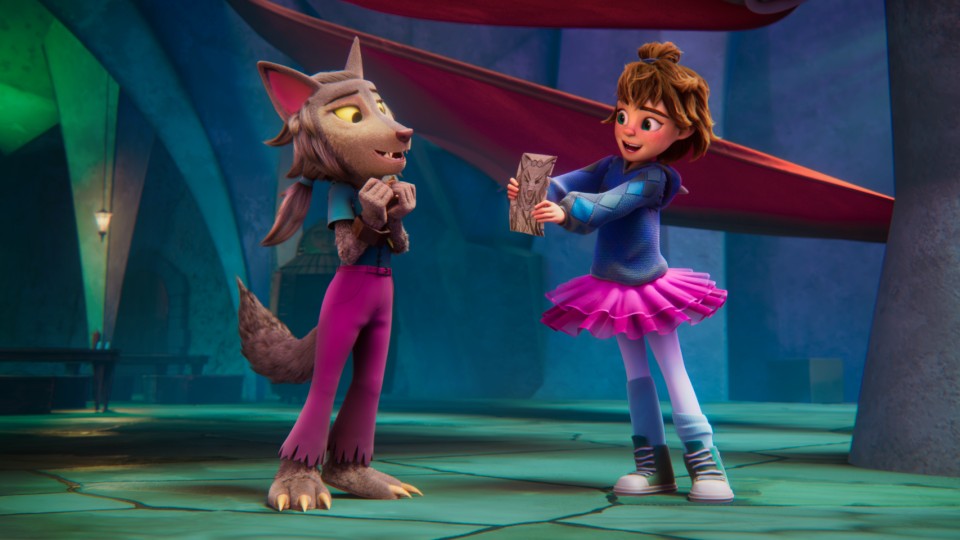
VERENA FELS: The idea was to create a stark contrast between the visual designs of the two worlds. The Primrose School world is very organized,
with an unrealistic Cotton Candy aesthetic; everything is orderly and clean, and anything that’s organic and natural has to
be trimmed and tidied up. We worked a lot with symmetries, developing clear camera concepts, and the colors are in exaggerated
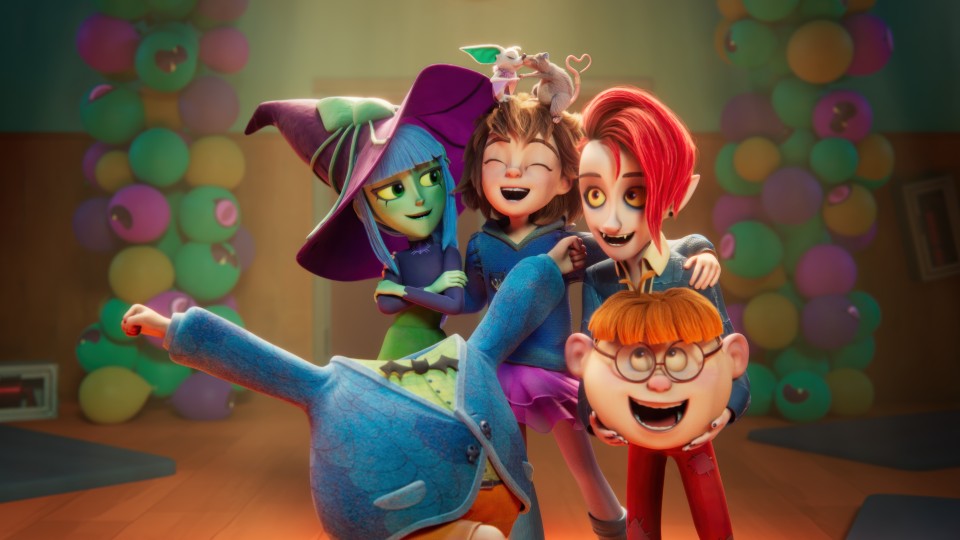
pastel and candy tones. The Rotwood School of Monsters represents the opposite: natural chaos rules there, with corners, edges,
oblique angles and disorder. The ruling concept is chaos, and it’s celebrated. Rotwood isn’t a creepy, dark monster world;
being there is fun, with considerable joie de vivre. In terms of color, there’s no pink; instead, there are saturated, earthy
natural tones that exude joy and untamed life energy. In Primrose Tower, the energy is put into boxes, while in Rotwood it’s
let out, and everyone is allowed to be the way he or she is.
How do you manage to get inside the imaginary world of very young cinema audiences and recognize their needs?
VERENA FELS: To be honest, that's very easy for me. When I make films, I naturally bear in mind the children who will see them, but I
make films that appeal to me, that I can stand by. First and foremost, I come up with something from my heart, and luckily,
that also appeals to the world of younger people. I have two children myself (four and seven), so I am confronted every day
with the way things are in their world, and I draw on that. On top of that, I get a lot of views from my students, who are
in their early twenties. And I really like to talk after children's screenings in the cinema. For me, directing means talking
to a lot of people, surrounding myself with input, listening to plenty of reactions. I absorb a lot, cook up something from
that and then put it out there.
How do the characters gradually take on their final form, in terms of facial features, physique and voice? What kind of balancing
act do you have to perform between the abstract and the tangible? Can you tell us more about that process?
VERENA FELS: When I read a character, I make a kind of character board for myself. I write down a lot of words and traits, and sometimes
things like pencil, chewing gum or whatever, that come to mind for each character. Then I put that in order and do the same
on the visual level. Once the imagery and the character traits are there, I go one step further and consider which people
or fictional characters spring to mind when I think of the film characters. For Simsala, the role model was Nina Hagen, with
her wild hair; for the janitor it was Mr. Bean, and for Olalia I thought of the elegance of Helen Mirren. I bring all that
together, and then I analyze again why certain aspects come to mind and try to crystallize them in conversation with the art
director. In the end, Simsala has little mushrooms in her hair, just like Nina Hagen often had strange things in her hair.
How are design possibilities expanding with the rapid development of the technology these days?
VERENA FELS: The technology is so advanced that with enough time and money, it’s possible to create photorealism. There are plenty of
examples of that, including all the Disney films now being translated into reality. But actually, we didn't want that – because
an animated film gives you the freedom to emphasize some things and push other things into the background by reduction. The
great thing about animated film is that you don't have to correspond to reality; the artistic design allows you to emphasize
a particular facet of a character. That's what I love about animated film: you can create a tailor-made world for your narrative.
With realism, you don’t get that option. In an animated film, every little detail is a decision. I consider that very enriching.
Which phase in the work gives you, as director, the greatest influence on the design? And conversely, which are the phases
where you have to let go?
VERENA FELS: I always think of a film crew as an organism. And my role in that is to be the heart, which pumps energy everywhere and provides
everyone with ideas, with joy, with guidance: that’s directing. I’m there whenever there are questions and uncertainties.
Often, I’m presented with absolute gifts, which makes me very happy and generates new energy for the people who made them.
I wouldn't say I'm more important in one area than another. I’d say I'm not that important everywhere. A special feature of
MONSTER MIA was the commitment Dunja Bernatzky displayed as producer, which also extended to the content. That was very extraordinary.
The contemporary relevance of the theme isn’t only related to the rapprochement that develops between two worlds which had
been hostile to one another. The story is also about withholding information and the manipulation associated with that. Today,
the young generation in particular has to find a way of dealing with information from digital media. How important was that
aspect to you?
VERENA FELS: The amazing thing about our story was that the longer we worked on the film, the more topical it became. Fact checking, fake
videos, AI... all that makes the theme increasingly relevant, and that issue won’t go away. As someone whose profession is
creating "realities" to tell stories, I’m very concerned about that. Which is why I think it's particularly important in my
work for it to remain apparent that the images are not real. I think it's more important than ever to challenge what we are
told, to ask where information comes from and whether it makes sense in a particular context. For me, it's also about being
open and considering different perspectives. It’s never been easier to get information than it is now. But that means we have
a greater responsibility than ever to decide clearly which sources we trust and to make comparisons with our own value system.
And this process is related to the second essential question of the film: Who do I want to be? What do I want to stand for?
Do I go along with what's happening right now? On the other hand, it’s important not to let individualism get out of hand
and turn into egoism. I’m in favor of a healthy individualism that still benefits the community as a whole.
In what ways can the two MONSTER MIA worlds, the Humans and the Monsters, have a particularly enriching influence on each
other?
VERENA FELS: The most important first step is to reach a point where they can influence each other at all, which means getting to know
each other, exchanging ideas and learning from each other. The problem with Primrose Tower is that it doesn’t permit individuality
and creativity, and it doesn’t acknowledge that there’s something good about being different. So the Primrose people can definitely
learn creative problem-solving skills from the monsters. The film shows, I hope, that the solution lies in creative chaos
and not in destructive chaos.
Interview: Karin Schiefer
June 2026
Translation: Charles Osborne