A careless moment, an edge, an abyss. Jessi's fall in the morning light. Suddenly her little sister, her mother and her boyfriend
have to keep on living with her absence. Sandra Wollner’s cinema is not confined to storytelling in a classical narrative
sense; instead, it traces states and perceptions, exploring attempts to find a modus vivendi when a person has been lost.
In EVERYTIME, memories and an unlived future become entwined in a displaced reality that can admit the unthinkable in the face of the
inconceivable.
EVERYTIME begins with a little girl complaining incessantly to her big sister. The family is presented as the dynamic location
for positional struggles – while at the same time it proves to have an established order that is fundamentally disrupted when
one element goes missing. Did you focus from the early stage of script development on the concept of family as a system?
SANDRA WOLLNER: The first scene thrusts us into the middle of normal family chaos: two sisters who always quarrel, everywhere, and a mother
who is calling an airline and kept on hold as she tries to organize their lives. People are arguing about not having enough
space, about food; they are constantly jostling to claim their place in the world. Meanwhile, somebody has an accident off-screen
everyone looks, but nobody stops, because it doesn't affect anybody else. It’s someone else's life. I was interested in the
chaos, the absence of connection between lives. In the early phase of the screenplay there were three characters: Ella, Melli
and Lux. They were the afterimages of people I've met during my life who were definitely an inspiration for this film. But
these afterimages developed lives of their own, which I pursued.
The first shots of Ella and her two daughters seem to be filmed through dense undergrowth. Which invisible entity is observing
in EVERYTIME?
SANDRA WOLLNER: This is always one of the most important questions for me. Who is actually watching? Movies always satisfy the deeply human
desire to be seen. We observe characters on the screen, and perhaps one reason that’s so pleasurable is that it somehow implies
the possibility that whatever happens to us is being observed by a kind of neutral authority. In EVERYTIME, our characters
are being observed by precisely this unnamed entity – which may be God, a spirit, existence itself or an extension of the
self. This perspective isn’t one of empathy: it takes the computer game just as seriously as the tragedy that is unfolding
before its eyes. From the perspective of this entity, the meaning behind what we think of as our story simply isn’t relevant.
The tension here is in the conflict: we have to count ourselves among the protagonists of existence, while at the same time,
for the universe itself we are just extras.
The abrupt end of a young existence could be seen as one of the links between EVERYTIME and your last film, The Trouble with
Being Born. What interests you about this theme?
SANDRA WOLLNER: Childhood and death were also a theme of my first film, The Impossible Picture – or the childlike perception of death. The
fact that children are always involved may be because, like me, they’re not yet able to grasp this life fully. They look at
the world without prejudice and, in a sense, without concepts. And with regard to death in particular, it doesn’t strike me
that an adult view contains an insight that wouldn’t be accessible to a child. Anecdotally, this may also be related to my
own childhood "death experiences" – there were several situations where I nearly died. But I think I’d still be interested
in this theme if I hadn't had these experiences.
Decisive events take place at sunrise or sunset. Jessie's boyfriend is called Lux. The sun which refuses to set on Tenerife
takes on the aspect of a screen. What dialogue with light are you conducting as a filmmaker in EVERYTIME?
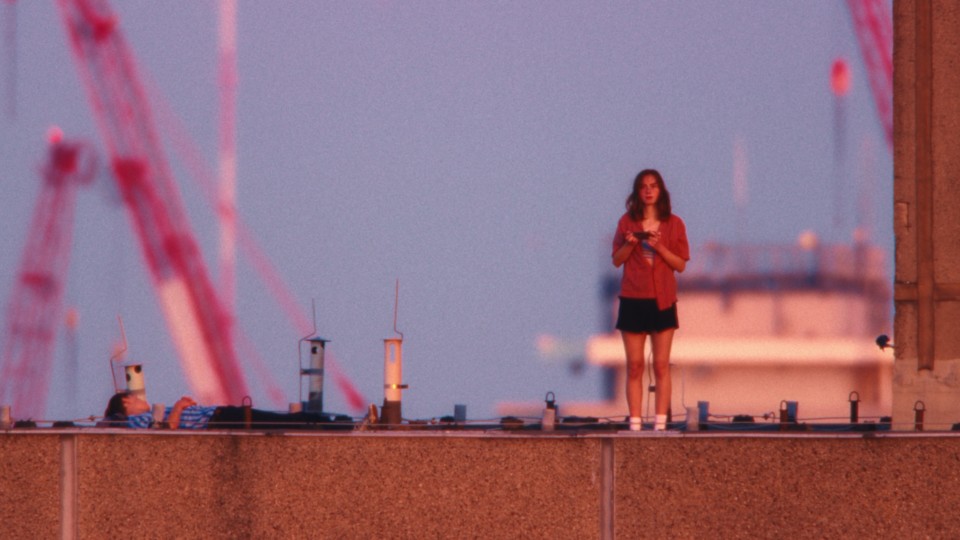
SANDRA WOLLNER: Jessie stands on this roof at the beginning of the film, deeply impressed by the sunrise, or by the feeling she has about
it – after a long night which also involved taking certain substances. The desire to know what she must have seen at the end,
and felt, prompts her mother to try the same drugs. And this has certain effects – via detours – in the last act of the film;
what happens to the sun then is just one of them. At the very end of EVERYTIME – when the journey actually seems to be over,
and unprocessed grief has resurfaced but brought nothing conclusive to light – we witness the appearance of a manifestation,
a "strangeness". Something that can't really happen is the consequence of Jessie's accident and death: her death is also something
that can't really have happened. Or shouldn’t have. How is it possible that the world simply keeps turning after a tragedy
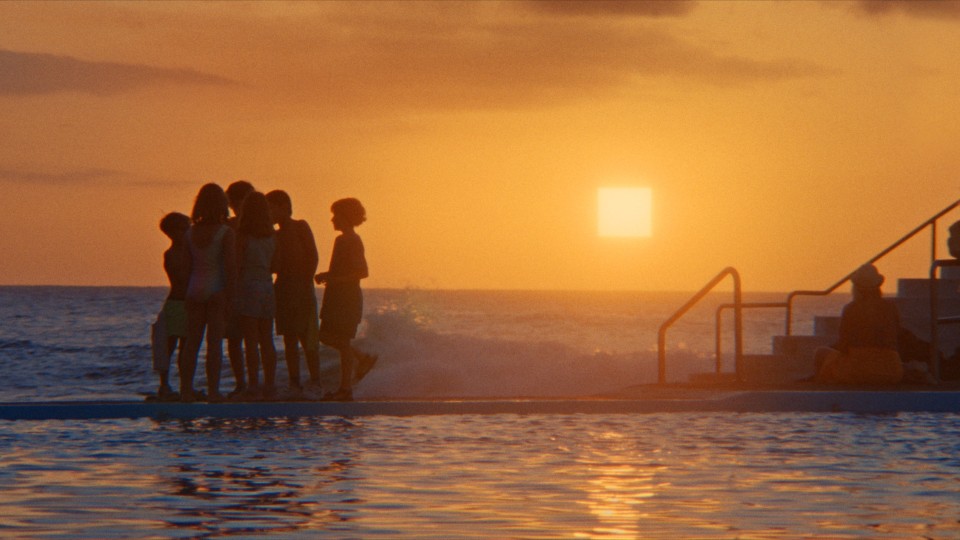
like that? Actually, the sun should stop moving. Instead, it hangs there and carries on shining as if nothing had happened.
I don't want to explain or pre-empt the ending, but I will say this much: it was important to me that the "strangeness" that
turns the world upside down for our main characters should also manifest itself in the sun and be visible to everyone else
– partly so that what is seen can't simply be dismissed as a dream or a trip.
The rugged volcanic rocks of the Canary Islands form the defining landscape here, which is also anticipated in a computer
game. What thoughts led to the choice of this landscape, and to its duplication on a virtual level?
SANDRA WOLLNER: In fact, the game came first. An important element in EVERYTIME is a sandbox game – the whole world consists of cubes, or
if you look at it two-dimensionally, rectangles/squares. The smallest unit in the composition of the world is always visible,
so to speak. Here it consists of little cuboids. They’re omnipresent, and though the texture varies, they’re always the same
size, uniform. There’s something both calming and uncanny about seeing the essence of things in this way – as a variant of
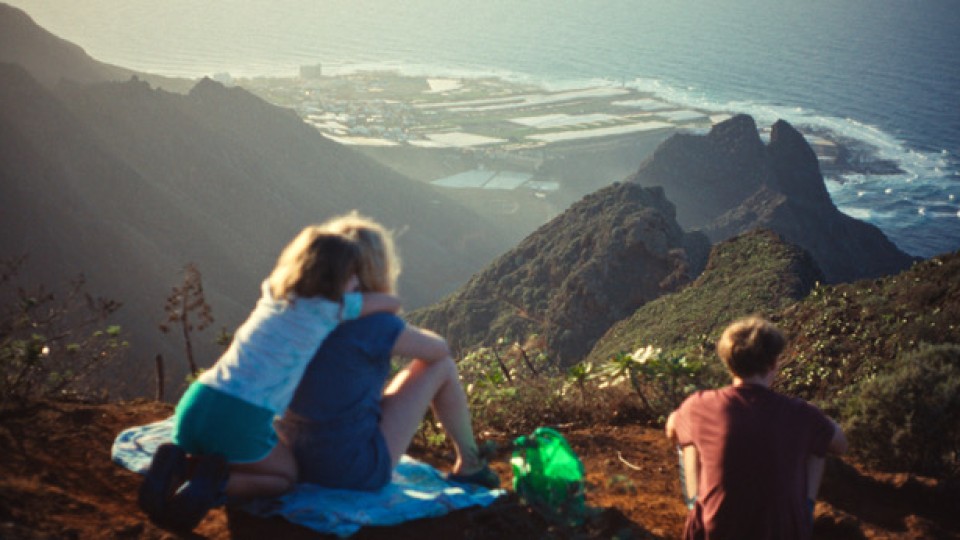
an endless Lego Duplo set. I went to Tenerife during the research phase, because I knew it would end in this "family vacation"
that never happened, and I fell in love with one place there. Punta del Hidalgo in the north of the country, a fishing village
right next to Chinamada, the mountain scenery that our characters admire from below and above. So the aesthetic parallels
to the game came about as if by themselves.
What thoughts did you have about the relationship between Lux and Ella, Jessie's mother?
SANDRA WOLLNER: We see two people who are trying to do everything right, for themselves and in their own way, but who aren’t honest – above
all, not with themselves. They don’t dare express their innermost needs. Basically, Lux wants forgiveness from Ella, which
she can’t give him. It’s just not in her power. When all this has been more or less talked through, nothing has been resolved.
They have to live in this intermediate state. Often in life, there’s more than one truth. I have the feeling that we’re usually
not very good at coping with that fact, and in the worst case, when faced with multiple contradictory truths, we become incapable
of action. Ella and Lux find themselves in precisely that dilemma. They make the best of it, in their own way – and fail.
EVERYTIME seems particularly interested in the idea that childhood constitutes a powerful world, through the character of
Melli. We see children who have minds of their own and articulate their demands. But doesn’t it also depict the loneliness
of children who are abandoned by adults?
SANDRA WOLLNER: Yes, I'm sure some people will read it that way. I myself have always felt that we see Melli's autonomy rather than her attempts
to cope with being abandoned. Everyone is trying to find a way to deal with their grief. We don't see Ella talking to Melli
about it, but the way they have embedded grief in their everyday lives indicates to me that they have talked about it. Melli
has her own way of dealing with her grief – the WhatsApp chat history on her phone, which she treats like a diary. Ella is
aware of this but lets it be Melli's thing. I didn't have the impression or narrative intention of a mother abandoning her
child with this feeling; it’s more the case of her understanding that everyone has their own perspective. In the last quarter
of the film, Melli becomes the main character, even the narrator. In an almost somnambulistic way, she takes over the "mourning
work" that the adults couldn’t do without her. This doesn’t mean she has understood something that her mother, for example,
couldn’t. But she has the perspective of a child who inevitably processes the death of her sister in a different way than
an adult does.
EVERYTIME depicts lush vegetation in parks, graveyards and forests, but it also features the transformation of nature (in
the computer game), and there are high temperatures – including, ultimately, a sun that doesn’t set. Did you consciously allow
ecological changes to resonate in the background?
SANDRA WOLLNER: I didn't write it as an ecopolitical piece, and I don't approach material in the light of a particular theme. But of course
the world and perceptions of this world have an influence on what I want to show. When I’m writing, I actually try to let
the writing have the space it needs, rather than checking everything for dramaturgical features or even some kind of message.
It’s often the sound of one sentence that drives me to the next, emerging from some unconscious level. Of course, there is
also the "normal" screenplay work, when analysis takes place. But a lot of the work involves letting these inexplicable phenomena
flow into a fluid whole, into a certain experience, no matter how strange that may be. Then some people are offended, because
what they expect doesn’t necessarily happen. But that's exactly what it's all about for me: perceiving cinema as a place for
"the inadmissible" to reality – because these things confront us with something for which our concepts are inadequate.
EVERYTIME is a story that is very much anchored in our current time. What thoughts led you to choose the much broader title?
SANDRA WOLLNER: Basically, EVERYTIME is the cosmos where all three of my previous films are set. A past that could also be a future, a location
where memory and imagination intertwine, the kind of fantasy that allows us our own, displaced reality; the place that shows
us our own horizon of experience, containing a sun that’s square and doesn’t set and a child that can come back – as if as
proof of an unbearably strong, ultimately irresolvable "yearning". The original term here, “Sehnsucht”, is a very German word
for a very metaphysical idea – but I think it's essentially about bonding, about our "attachment", our memory of everything
that is important to us and makes us "human". Perhaps the most "human" thing of all is the senseless hope that everything
important to us will somehow etch itself in a kind of eternity, in a simultaneity – of the past, our memories, our hopes and
dreams, and our actual future.
Interview: Karin Schiefer
April 2026
Translation: Charles Osborne