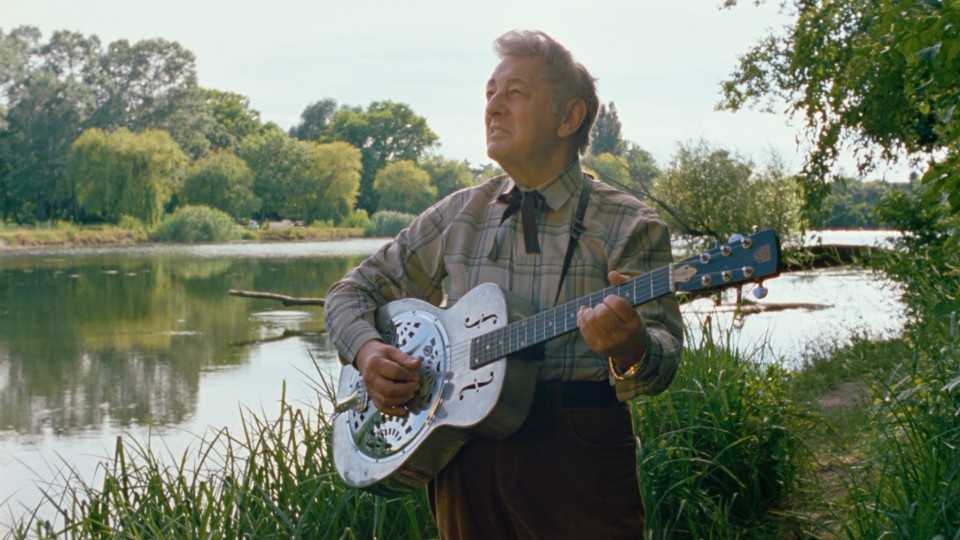
The most powerful bond in Al Cook's life would seem to be with Vienna. He lives in the apartment where he grew up, in the
city he has never left. But his music comes from somewhere else. The guitarist has internalized the blues rhythms of the Mississippi
Delta as if he had absorbed them there. His beloved Viennese home is bursting with nostalgia and memories – of his best years,
of his great love. But these days there’s no place on the Viennese housing market for dreamers like him. Tizza Covi and Rainer
Frimmel's THE LONELIEST MAN IN TOWN is a homage to the spirit of resistance and the determination to reject compromise.
Sometimes people you have known for a very long time become the protagonists of your films, while in other cases one quite
specific encounter leads you to work with a person. What sort of connection did you have with Al Cook?
RAINER FRIMMEL: Al Cook is one of the protagonists we have been friends with for a very long time. We discovered what we know about his life
over many conversations, long before the idea of making a film was floated.
TIZZA COVI: We were aware that a film with him would be a lovely project, but difficult as well, because he is a very independent artist:
someone who wants to be in sole charge. He has always had complete control over his artistic work, from his pieces of music
– which he sings and plays himself – to the design of the record cover. His artistic approach is similar to ours. He works
mainly as a team of one person and often performs alone, although he also has a loyal band. So he wanted to have a say in
the making of the film too, of course, and we went back and forth for a long time until he came to trust our concept. We tried
to convey to him that to a certain extent he would be a protagonist playing himself, but he would also be a role model for
a lot of other people who are in similar situations.
RAINER FRIMMEL: What fascinated us was that this talented blues guitarist performs in very small venues sometimes, and at other times on
a much larger scale – always refusing to compromise about his musical vision. For us, he’s a symbol of all those artists whose
commitment to authenticity means sacrificing the opportunity to be seen or heard more widely. It’s a question we also ask
ourselves again and again: to what extent must you be prepared to compromise in order to achieve something?
Did you at some point consider making a documentary, in the style of Notes from the Underworld, or was fiction always the
option that better suited Al Cook?
TIZZA COVI: We always wanted to make a feature film. Al Cook has presented his life story in a very comprehensive autobiography, but we
felt strongly that these factual details should only play a minor role in our narrative. We also wanted to make a film without
much dialogue, especially because The LONELIEST MAN IN TOWN is about loneliness and loss: both topics that are difficult to
put into words.
How can Al Cook be described as a musician?
TIZZA COVI: Al Cook started making music when he was about fourteen years old. The key experience for him was going to the cinema and
seeing Elvis Presley for the first time. Thanks to a neighbor who always played blues records with the window open, he came
to realize that this was the music through which he could express his innermost being. He has heard, played and lived nothing
but the blues.
RAINER FRIMMEL: Al taught himself everything he knows: how to play musical instruments, how to sing in English with a Southern accent even
though he’s never been to the USA in his life. His present wife, Brigitte, calls him the Karl May of music. (NOTE: the famous
German novelist Karl May wrote extensively about the Wild West despite never having been there). The recordings from his most
successful period, in the late sixties and seventies, really suggest that he could have had an international career if he
hadn't been so adamant about not compromising.
Was his apartment, with the studio he set up in the basement, so visually powerful that the theme of home – and the prospect
of losing that home – became central to the narrative?
TIZZA COVI: For us, his basement studio, where he spends a lot of time, was really crucial. It feels like a sort of secret retreat, which
gives us the opportunity to look inside his personality. And the apartment, where he was born and still lives, also speaks
of a different era. So the apartment and the basement studio are both important protagonists. This naturally tied in with
the theme of people being forced out of their homes, since so many old houses are being demolished in Vienna right now, and
long-term tenants are often treated very ruthlessly.
RAINER FRIMMEL: This struggle against invisible forces symbolizes his whole life, which is dominated by resistance to change. In our previous
films we worked in a far more documentary style; we took the rooms as we found them. On this film, we worked with set designers
for the first time. Since Al had already emptied his apartment for the forthcoming renovations, the set designers combed through
all his possessions, together with him, and rebuilt the rooms in reduced fashion.
THE LONELIEST MAN IN TOWN tells the story of a person who leads his "little", modest life and has appropriated the blues world
of the Mississippi Delta without doing any travelling. So although the film is also about loneliness, isn’t it first and foremost
the story of a lived passion?
TIZZA COVI: That's nicely put; yes, it's the story of a lived passion, because Al Cook is Viennese and yet has the blues in him, even
though he’s never been to the USA. But America has very often been with him. He got to know a lot of blues originals in Vienna,
musicians he admired very much, and he played with them in Vienna's legendary Jazzland club.
RAINER FRIMMEL: It's a passion combined with an absolute uncompromising attitude – and an extraordinary talent. When these three factors
come together, personalities like Al Cook are the result.
If anything bears witness to his passion, it is his collections – such as his material on Elvis – which could fill a small
museum. Does everything here come from his own collections?
TIZZA COVI: We only show objects that he actually owns. The 8 mm film projector, the records, the VHS cassettes, his Elvis collection.
RAINER FRIMMEL: When he does something, he does it thoroughly. He has collected everything about Elvis that was published in the fifties and
sixties.
Objects are a central feature of the visual composition, and you often film them in close-up. There are scenes with very little
light. What factors influenced your approach to visual design?
TIZZA COVI: The question facing us was: How can you show loneliness and loss? Together with our assistant Lennart Hüper, Rainer developed
a visual language which also conveys a lot by means of details, in fixed shots with careful composition.
RAINER FRIMMEL: Haptics is also something that is disappearing. However, memory is best transported by means of objects that can be touched.
Al often wanders around his apartment, looking at objects in his collection, and each one triggers a stream of memories. He
is someone who lives very much in his memories. As far as the lighting goes, we remained true to our principle of working
as far as possible with natural and existing light; Lennart helped us here by creating very discreet lighting. Previously,
with camera work of a very documentary nature, I always had to capture something in a matter of minutes. With this film there
was time to work on a shot, to set the light and choose the details, and that was very nice for me.
Was it also important for you to adopt a humorous and affection perspective on the people of this city?
TIZZA COVI: For me, the most important thing in cinematic work is to incorporate humor into drama. The older I get, the more uncomfortable
I feel with movies that don’t even make me smile. We never aim for comedy, but we work with people who have this comedy within
them; the situational comedy arises from the fact that things aren’t rehearsed or copied exactly. Taking an affectionate view
of us humans is the elixir of life for us.
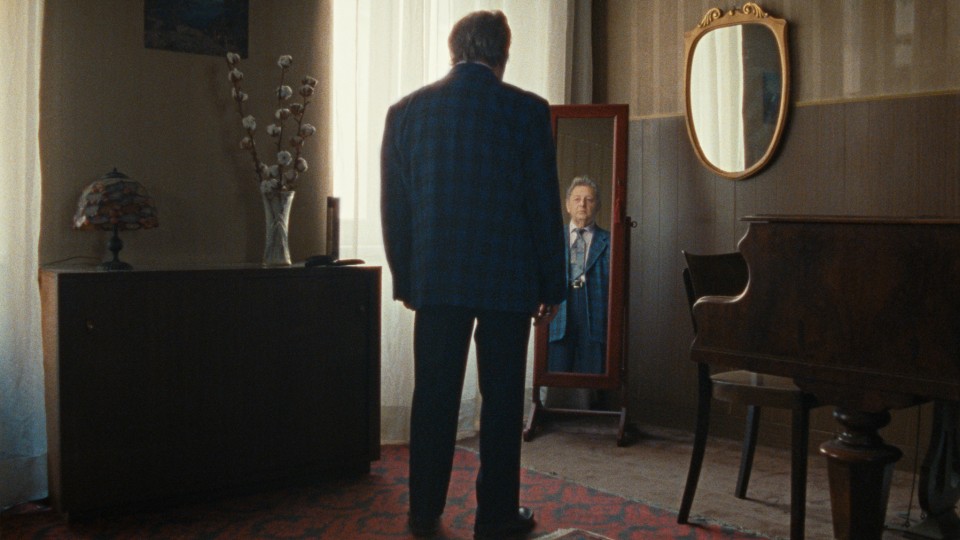
In visual terms, your films often contain little references to your other works; I'm thinking for example of Al getting dressed
in front of the mirror, which reminds me of Kurt Girk...
TIZZA COVI: What unites our films is that we always engage completely with a personality. In the case of Al Cook, his appearance plays
a major role. It’s very important to him that his hair is properly styled, that he’s perfectly dressed in the style of the
fifties: the end of that decade was also when his world ceased to move on.
RAINER FRIMMEL: We can't deny that we have personal preferences; for example, we’re very fond of Super 8 film. We pose the question of what
photography and film do to memory. How will Al react when he sees himself in old films? His face alone says a lot. For me,
that's what film is all about; being able to work without many words, just through images that create emotions.
TIZZA COVI: If you want to make a film without much dialogue, you need a very charismatic person. And Al has incredible charisma.
How did you deal with the choice of music for this film?
TIZZA COVI: First, we asked Al which songs he would like to have in the film, and then we made a selection. The Loneliest Man in Town
was his biggest hit, and it also provided the title for the film, but then there are others by artists including Lonnie Johnson,
Bertha Chippie Hill and Robert Johnson.
RAINER FRIMMEL: And he wrote one song especially for the film, the one he records in the scene in the basement: If I Had Money Just Like Henry
Ford.
Towards the end, there are some very powerful moments in the film when the apartment is gradually overcome by emptiness. How
did that come about?
TIZZA COVI: As always, we tried to shoot chronologically, and that meant removing things one at a time, as he sells them. The increasing
emptiness was also an emotional aspect that came as a surprise to us. But it was stipulated in the script that Al wouldn’t
sell the record player, so he could play a record before leaving the apartment.
RAINER FRIMMEL: If you know how attached Al is to the collections he has built up throughout his life, it's even more touching to stand with
him in an empty room, when it really isn’t clear how his life will continue.
There are two kinds of hope: on the one hand, a lot of the things he sold to younger people will live on, and on the other
hand, there is the possibility that he could still live his dream. His life strikes me as both an unfulfilled and a fulfilled
dream, at the same time.
TIZZA COVI: That's a very fine thought. We left it open because we didn't know ourselves how he would decide.
Interview: Karin Schiefer
December 2025
Translation: Charles Osborne